

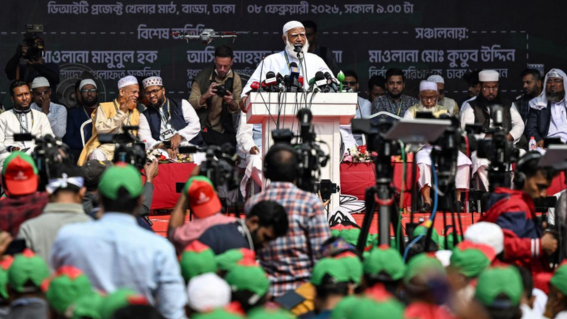
9 February 2026 (Navroze Bureau) : In a sharp political message widely interpreted as being directed at India, the chief of Jamaat-e-Islami has said that the upcoming election will deliver a decisive “red card” to what he described as forces of “hegemony and domination.” The remarks have added a new layer of political rhetoric ahead of the crucial polls and drawn attention across the region.
Addressing a public gathering, the Jamaat chief said the election would not merely be a contest of parties but a referendum on sovereignty, dignity, and self-determination. Without naming India directly in every instance, his comments were framed as a warning against external influence and pressure.
Strong Political Messaging
The Jamaat leader asserted that voters were ready to reject “imposed narratives” and “external control,” claiming that public sentiment was turning decisively against forces perceived as dominant or interventionist.
“The ballot will speak louder than words,” he said, adding that the election outcome would reflect the people’s rejection of political and economic hegemony. The phrase “red card,” borrowed from football terminology, was used to signal a firm and final rejection.
Political observers say the statement appears aimed at mobilising Jamaat’s core support base while also appealing to nationalist sentiment during the election season.
Election as a Symbolic Battle
According to the Jamaat chief, the forthcoming vote represents more than a routine democratic exercise. He described it as a turning point where citizens would reclaim their political voice and send a strong signal to regional powers.
“This election is about dignity, justice, and independence,” he said, urging supporters to participate in large numbers and remain united.
Analysts note that such rhetoric has often been used by Islamist and opposition leaders to frame elections as a struggle against external influence, particularly when relations with India dominate political discourse.
Regional and Diplomatic Implications
The remarks have been closely watched in diplomatic circles, as India remains a key regional player with strategic, economic, and political interests. While Indian officials have not reacted publicly, experts say such statements could further strain already sensitive relations.
“This kind of language is meant more for domestic consumption,” a regional affairs expert said, “but it inevitably resonates beyond borders.”
Political Reactions at Home
Within the country, reactions have been mixed. Supporters of Jamaat praised the speech as bold and principled, while critics accused the party of using confrontational rhetoric to polarise voters and distract from governance issues.
Opposition leaders also questioned whether such statements would help address everyday concerns such as employment, inflation, and public services.
Looking Ahead
As campaigning intensifies, the Jamaat chief’s comments are expected to be replayed and debated widely. Whether the “red card” rhetoric translates into electoral gains remains to be seen, but it has undeniably added sharpness to the political narrative ahead of polling day.
Summary
Ahead of elections, the Jamaat chief issued a strong message interpreted as aimed at India, saying voters would show a “red card” to forces of hegemony through the democratic process.