

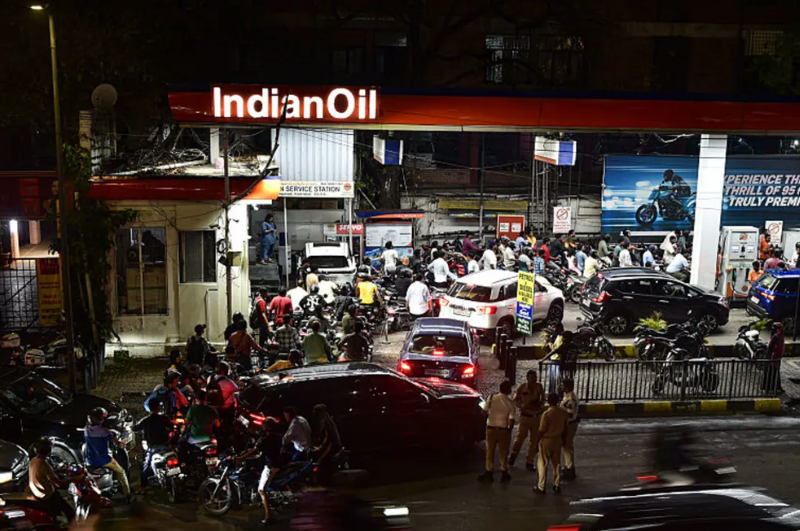
30 March 2026 (Navroze Bureau) : India’s economic outlook is facing renewed uncertainty as the ongoing Iran war begins to ripple across global energy markets, trade routes, and financial systems. For New Delhi, the stakes are particularly high. As one of the world’s largest importers of crude oil and gas, India is acutely vulnerable to disruptions in West Asia, and the consequences are already becoming visible in slowing growth projections, rising inflation risks, and concerns over a widening fiscal and current account deficit.
At the heart of the issue lies India’s dependence on imported energy. The country imports nearly 90% of its crude oil and a significant portion of its natural gas needs. A large share of these imports passes through the Strait of Hormuz, a critical chokepoint now affected by the Iran conflict. Disruptions in this region have pushed global oil prices above $100 per barrel, significantly increasing India’s import bill and putting pressure on its macroeconomic stability.
Economists have already started revising India’s growth forecasts downward. Major financial institutions now expect GDP growth to slow to around 6.5% in 2026, compared to earlier projections closer to 7%. The slowdown is being driven by multiple factors, including weaker consumption, rising input costs for industries, and disruptions in supply chains. Sectors such as aviation, cement, and oil marketing are expected to face earnings pressure as fuel costs surge.
Inflation is another growing concern. Higher crude prices directly translate into increased transportation and manufacturing costs, which eventually feed into consumer prices. In addition, shortages of liquefied petroleum gas (LPG) have already begun affecting households and small businesses, creating a ripple effect across the economy. The risk is that inflation could undo recent gains made by policymakers in stabilizing prices, forcing the central bank to reconsider its monetary policy stance.
The situation has also complicated the task of the Reserve Bank of India (RBI). India had recently enjoyed a “Goldilocks” phase of high growth and low inflation, but the Iran conflict has disrupted this balance. Policymakers are now caught between the need to control inflation and the necessity of supporting economic growth. Any tightening of interest rates to curb inflation could further slow economic activity, while a loose policy risks fueling price pressures.
On the fiscal front, the government faces mounting challenges. To shield consumers from rising fuel prices, authorities may be forced to cut excise duties or increase subsidies, particularly on fuel and fertilizers. While such measures can provide short-term relief, they come at the cost of reduced government revenue and higher expenditure. Experts warn that prolonged conflict could widen India’s fiscal deficit and strain public finances in the coming years.
The current account deficit (CAD) is another area of concern. As oil prices rise, India’s import bill increases, leading to a larger gap between imports and exports. This can weaken the Indian rupee and increase external vulnerability. A weaker currency, in turn, makes imports more expensive, further fueling inflation.
Indian businesses are also feeling the impact. Companies with global exposure are experiencing longer supply chains, higher transportation costs, and delays in payments. These factors are stretching working capital cycles and squeezing margins, particularly for industries dependent on imported raw materials. While the immediate impact on profits may be limited, prolonged disruptions could lead to broader financial stress across sectors.
Financial markets have reacted sharply to the unfolding crisis. Indian equities have seen significant declines amid rising oil prices and global uncertainty. Investor sentiment has weakened, with foreign capital outflows adding to market volatility. Analysts warn that continued geopolitical tensions could further dampen investment and delay economic recovery.
Energy security has emerged as a critical concern for India. With a large portion of its oil and gas imports tied to the Middle East, the country’s vulnerability to geopolitical shocks is evident. The current crisis has renewed calls for diversifying energy sources, increasing domestic production, and accelerating the transition to renewable energy.
Despite these challenges, policymakers remain cautiously optimistic. The government has indicated that it has sufficient fiscal space and policy tools to manage short-term shocks. However, the longer the conflict persists, the more difficult it will become to balance growth, inflation, and fiscal stability.
In conclusion, the Iran war has introduced a new layer of complexity to India’s economic landscape. While the country is not directly involved in the conflict, its economic interdependence with global energy markets makes it highly susceptible to external shocks. The coming months will be crucial in determining how effectively India can navigate these challenges and sustain its growth momentum in an increasingly uncertain global environment.
Summary
Iran war disrupts oil supply, slowing India’s growth, raising inflation, and widening deficits. Policymakers face tough choices as economic stability comes under pressure from global geopolitical tensions.