

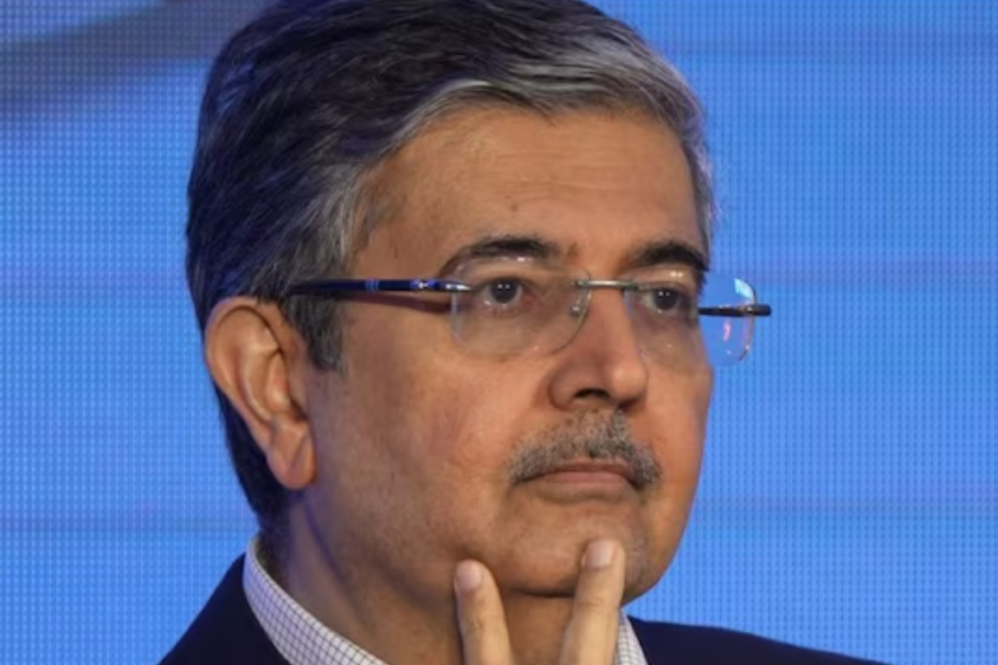
May 12: 2026 (Navroze Bureau) : Veteran banker Uday Kotak has sparked wide discussion after calling for “more Brahma and Mahesh, less Vishnu” while outlining his vision for building a stronger and more competitive India economy.
Using a symbolic reference to the Hindu trinity, Kotak emphasized the need for India to focus more aggressively on creation, innovation, transformation, and disruption rather than excessive preservation of outdated systems and structures.
The remarks quickly drew attention from business leaders, economists, entrepreneurs, and policymakers due to their broader implications for India’s economic strategy.
Understanding the ‘Brahma, Vishnu, Mahesh’ Analogy
In Hindu philosophy:
- Brahma represents creation
- Vishnu symbolizes preservation
- Mahesh (Shiva) signifies transformation and destruction leading to renewal
Uday Kotak used this framework metaphorically to argue that India needs:
- More creators and innovators
- More willingness to disrupt inefficient systems
- Faster institutional transformation
- Greater entrepreneurial risk-taking
while reducing excessive focus on maintaining status quo structures.
Focus on Economic Dynamism
Kotak’s comments reflect a broader argument that rapidly growing economies require constant reinvention and adaptation.
According to analysts, the banker appeared to suggest that India should:
- Encourage innovation-driven industries
- Modernize institutions
- Promote technological disruption
- Improve productivity
- Reduce bureaucratic inertia
to remain globally competitive.
India’s Growth Moment
India is currently viewed as one of the world’s fastest-growing major economies.
The country has seen rapid expansion in sectors such as:
- Digital technology
- Financial services
- Manufacturing
- Startups
- Infrastructure
However, economists also note persistent challenges involving:
- Employment generation
- Regulatory complexity
- Income inequality
- Productivity gaps
- Institutional efficiency
Kotak’s remarks appear connected to these broader economic debates.
Need for Risk-Taking and Innovation
Business leaders increasingly argue that innovation ecosystems thrive when economies reward experimentation and calculated risk-taking.
Kotak’s call for “more Brahma and Mahesh” was interpreted by many as support for:
- Entrepreneurship
- Creative destruction
- Startup ecosystems
- Industrial modernization
- Technological adaptation
Experts say countries that adapt quickly to technological and global shifts often gain long-term economic advantages.
Balancing Stability and Disruption
While advocating transformation, economists caution that stable institutions also remain essential for sustainable growth.
“Vishnu,” representing preservation, can symbolize:
- Financial stability
- Institutional continuity
- Regulatory trust
- Social balance
Therefore, some analysts interpreted Kotak’s comments not as rejection of stability but as a call to avoid excessive resistance to change.
India’s Startup and Digital Economy
India’s startup ecosystem has grown dramatically over the past decade, producing major companies in:
- Fintech
- E-commerce
- Artificial intelligence
- Software services
- Digital payments
The country has also become a global center for digital public infrastructure and technology adoption.
Kotak’s remarks align with ongoing discussions about how India can move from a service-driven economy toward higher innovation-led growth.
Economic Reform Debates Continue
The comments also feed into larger debates regarding economic reform priorities in India.
Experts frequently discuss the need for:
- Faster judicial processes
- Regulatory simplification
- Labor reforms
- Manufacturing competitiveness
- Capital market expansion
Many economists argue that reducing inefficiencies can unlock higher long-term growth.
Corporate India Responds
Business circles and social media users reacted strongly to Kotak’s metaphorical remarks.
Some praised the comments as:
- Visionary
- Bold
- Culturally relatable
- Reflective of economic reality
Others argued that preserving institutional stability remains equally important during periods of rapid transformation.
Global Competition Intensifying
India currently faces growing competition from other economies seeking to attract:
- Manufacturing investment
- Technology capital
- Supply chain diversification
- Innovation ecosystems
Economists say maintaining high growth rates will require constant modernization and policy adaptability.
Financial Sector Perspective
As one of India’s most influential bankers, Uday Kotak has often spoken about:
- Capital allocation
- Financial discipline
- Economic resilience
- Long-term institution building
His latest remarks suggest growing emphasis on transformation-oriented growth models.
Young Entrepreneurs Central to Vision
Analysts say India’s demographic profile gives it significant potential for innovation-driven growth.
Young entrepreneurs and technology professionals are increasingly shaping:
- Digital commerce
- AI development
- Manufacturing automation
- Global outsourcing
- Consumer technology
Kotak’s comments may resonate particularly strongly within startup and technology communities.
Conclusion
Uday Kotak’s call for “more Brahma and Mahesh, less Vishnu” has ignited discussion about the balance between innovation, transformation, and stability in India’s economic future.
By using a culturally familiar metaphor, Kotak highlighted the importance of creativity, disruption, and institutional renewal as India seeks to strengthen its global economic position in an increasingly competitive and technology-driven world.
Summary:
Uday Kotak urged India to focus more on innovation and transformation than preserving outdated systems, using the “Brahma, Vishnu, Mahesh” analogy to explain his economic growth vision.