

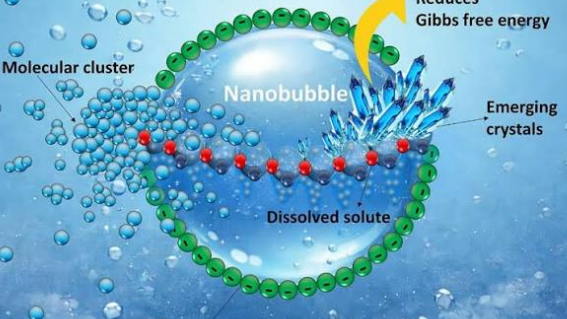
13 October 2026 (Navroze Bureau) Researchers at the Indian Institute of Technology (IIT) Ropar have identified a promising approach that could make pharmaceutical manufacturing more efficient and environmentally sustainable. A new study shows that microscopic bubbles known as nanobubbles can improve the crystallisation of paracetamol, helping produce smaller crystals, accelerate crystal formation and increase manufacturing yields.
The research explores how nanobubbles can improve a crucial process used in pharmaceutical production. Crystallisation helps separate and purify drug compounds, while the size and distribution of crystals can influence the quality, processing and dissolution behaviour of medicines. The findings suggest that nanobubble-assisted crystallisation could offer manufacturers a cleaner alternative to some conventional methods of controlling crystal formation. <Cite refs={[“turn573747search0″,”turn573747search1”]}/>
What Are Nanobubbles?
Nanobubbles are extremely small gas bubbles, typically measuring just a few hundred nanometres or less, making them invisible to the naked eye. Because of their small size and substantial surface area relative to their volume, they can influence interactions between gases and liquids.
In the IIT Ropar study, researchers investigated nanobubbles measuring approximately 150–200 nanometres in diameter. They introduced different gases, including oxygen, nitrogen and carbon dioxide, into a paracetamol-containing solution to examine how the bubbles affected crystal formation.
The researchers found that nanobubbles could encourage crystallisation under conditions where conventional methods did not produce crystals. Their findings indicate that the bubbles can provide surfaces on which dissolved drug molecules begin forming solid crystals, a process known as nucleation. <Cite refs={[“turn573747search0″,”turn573747search1”]}/>
How Nanobubbles Could Improve Drug Manufacturing
Crystallisation is an essential step in producing many pharmaceutical ingredients. Manufacturers must control crystal size and distribution to achieve consistent product quality and make subsequent processing more predictable.
Conventional crystallisation can present challenges, including slow crystal formation, inconsistent particle sizes and lower-than-desired yields. Adjusting temperature, mixing conditions and solvent composition can help, but achieving consistent results remains difficult.
Nanobubbles could address some of these challenges by providing additional sites for crystal formation. Their surface properties may encourage dissolved molecules to gather and form crystal nuclei more readily, reducing the energy barrier associated with nucleation.
The IIT Ropar research found that nanobubbles accelerated crystal formation and helped produce smaller, more uniform paracetamol crystals. The researchers also observed improved yields across the operating conditions examined. <Cite refs={[“turn573747search1″,”turn573747search2”]}/>
Study Reports Significant Improvements in Crystal Size and Yield
The study examined both cooling crystallisation and antisolvent crystallisation. Cooling crystallisation encourages crystals to form as a solution cools, while antisolvent crystallisation involves introducing another liquid to reduce the compound’s solubility.
By combining these approaches with nanobubbles, the researchers investigated how temperature, the amount of antisolvent, gas type and stirring speed influenced the resulting crystals.
The findings showed that nanobubbles could reduce crystal size substantially under certain experimental conditions. The researchers reported maximum crystal-size reductions of approximately 50% and 62% at a temperature of 25°C under two higher-antisolvent conditions.
The experiments also indicated that nanobubbles could initiate crystal formation at lower antisolvent concentrations and under conditions where the conventional process failed to generate crystals.
The study reported higher crystal yields when nanobubbles were present. These results point to a potential way to improve material utilisation and reduce losses during pharmaceutical ingredient production. However, the findings come from controlled experiments and require further evaluation before their benefits can be assumed at industrial scale. <Cite refs={[“turn573747search0″,”turn573747search1”]}/>
Why Smaller Crystals Matter
Crystal size can influence several important properties of pharmaceutical ingredients, including dissolution rate, filtration, drying and downstream processing.
Smaller crystals generally provide a greater surface area relative to their volume, which can help a drug dissolve more quickly under appropriate conditions. Faster dissolution may contribute to improved drug availability in some formulations, although the actual effect depends on the drug’s properties, formulation and other factors.
Producing smaller and more uniform crystals could also help manufacturers improve consistency between production batches. Better control over particle characteristics may make it easier to optimise processes and reduce difficulties during purification and formulation.
Nevertheless, smaller crystals do not automatically translate into a more effective medicine. Pharmaceutical products must undergo appropriate testing to establish their quality, safety, stability and performance.
A Potentially Greener Alternative
The research is also significant because nanobubbles could provide a relatively non-invasive way to influence crystallisation without introducing additional chemical additives specifically to trigger nucleation.
Compared with some alternative techniques, nanobubble-assisted processing may offer advantages in energy use and equipment requirements. Earlier research by the IIT Ropar team, published in ACS Sustainable Chemistry & Engineering in 2026, also reported that nanobubble-assisted cooling crystallisation reduced crystal size and shortened the time needed for crystals to form. <Cite refs={[“turn573747search2″,”turn573747search5”]}/>
If the approach can be implemented successfully at scale, pharmaceutical manufacturers could potentially improve production efficiency while limiting certain process-related environmental impacts.
However, a cleaner manufacturing process must be assessed across its entire lifecycle. Gas generation, energy consumption, solvent use, equipment requirements and waste management will all need to be considered before the technology’s overall environmental benefits can be established.
Challenges Before Industrial Adoption
Despite the promising results, further research is needed to determine how consistently nanobubble-assisted crystallisation will perform in large industrial reactors.
Maintaining a stable concentration of nanobubbles, controlling crystal size across large production batches and ensuring reproducible results are important technical challenges. Manufacturers will also need to establish suitable operating conditions for different drug compounds rather than assuming that results obtained with paracetamol will apply to every medicine.
Additional studies will be required to evaluate process economics, product quality and compatibility with existing pharmaceutical manufacturing systems.
What the Findings Mean for the Pharmaceutical Industry
The IIT Ropar study offers a potential route towards more controlled and efficient pharmaceutical crystallisation. By encouraging earlier crystal formation and improving particle-size control, nanobubbles could help manufacturers increase yields and optimise the production of active pharmaceutical ingredients.
The research also highlights how advances in chemical engineering can contribute to more sustainable medicine manufacturing. Although commercial adoption will depend on further validation and scale-up, nanobubble technology represents a promising area for future pharmaceutical process development.