

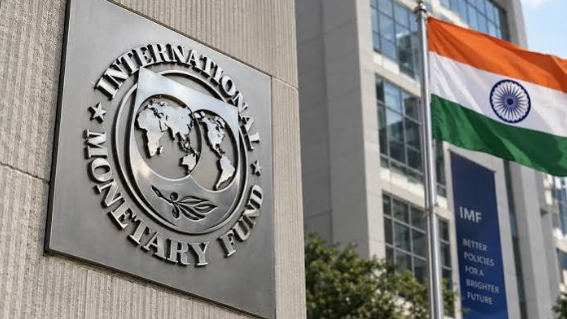
13 October 2026 (Navroze Bureau) India is expected to maintain strong economic growth, with the International Monetary Fund (IMF) projecting the country’s gross domestic product (GDP) to expand by 7% in the 2027–28 financial year. The forecast places India among the fastest-growing major economies, even as advanced economies continue to experience comparatively moderate growth amid geopolitical tensions, higher energy costs and uncertainty surrounding the global economic outlook.
In its latest World Economic Outlook update released on October 13, 2026, the IMF raised India’s growth projection for the current financial year, FY2026–27, to 7%, up from its earlier estimate of 6.4% announced in July. The Fund also revised its projection for FY2027–28 to 7%, compared with its previous estimate of 6.7%. <Cite refs={[“turn325599news0″,”turn325599news8”]}/>
Strong Domestic Demand Supports India’s Growth
The IMF attributed the upward revision to stronger-than-expected economic momentum, supported by resilient domestic demand and robust activity in the services sector. Favourable demographic trends, India’s expanding domestic market and continued structural reforms were also identified as factors supporting its medium-term growth potential.
The revised outlook indicates that domestic consumption and services activity are expected to remain important drivers of economic expansion. India’s growing role in technology-related activities could provide additional support as global investment in artificial intelligence and digital infrastructure continues.
The revision also follows similar upward adjustments by other institutions. The Reserve Bank of India and the World Bank have projected India’s economic growth at 7.1% for FY2026–27, reflecting expectations of continued economic momentum. <Cite refs={[“turn325599news0″,”turn325599news8”]}/>
Global Growth Remains Uneven
While India is expected to maintain a relatively strong expansion rate, the global economy continues to face several challenges. The IMF raised its global growth forecast for 2026 marginally to 3.1%, from 3% in its July assessment. For 2027, the global growth projection remains unchanged at 3.4%.
The Fund’s assessment highlights the uneven impact of geopolitical developments, technological investment and energy-market disruptions on different economies. Countries with strong technology industries and exposure to artificial intelligence investment may benefit from additional capital spending, while energy-importing economies face greater pressure from elevated fuel prices.
Advanced economies are projected to grow by approximately 2.1% in 2026, compared with 2% in 2025. However, growth prospects vary significantly across individual countries, depending on domestic demand, energy dependence, fiscal policy and technology investment. <Cite refs={[“turn325599news1″,”turn325599news8”]}/>
United States and European Economies Face Different Prospects
The IMF expects the United States economy to grow by 2.3% in 2026. Private consumption, fiscal measures and investment in artificial intelligence are expected to support economic activity, although uncertainty surrounding inflation and financial conditions remains.
The euro area is projected to expand by 1.1% in 2026, an improvement over the IMF’s previous estimate of 0.9%. Investment linked to artificial intelligence, activity in technology-related supply chains and higher defence spending are among the factors supporting the revised outlook.
China’s economic growth is projected at 4.5% in 2026 and 4% in 2027. Higher oil prices, domestic demand concerns and structural challenges are expected to weigh on its expansion. These differences underline the increasingly varied growth trajectories of major economies. <Cite refs={[“turn325599news1″,”turn325599news8”]}/>
Oil Prices and Geopolitical Risks Remain Major Concerns
Higher energy prices remain a significant risk to the global economic outlook. The ongoing conflict in the Middle East has disrupted market expectations and contributed to concerns about oil supply and inflation.
The IMF’s October assessment assumes an average crude oil price of approximately $95.74 per barrel in 2026, followed by a decline to around $87.39 in 2027. These assumptions highlight the potential economic impact of sustained energy-market uncertainty.
For India, which depends heavily on imported crude oil, elevated prices can increase import costs, put pressure on the current account balance and contribute to domestic inflation. Higher fuel and transportation expenses may also affect businesses and household purchasing power.
The IMF has warned that an intensification of geopolitical conflicts, rising government borrowing costs and weaker-than-expected returns from artificial intelligence investment could undermine global growth. <Cite refs={[“turn325599news0″,”turn325599news1”]}/>
What the Outlook Means for India
India’s revised growth forecast reflects the strength of its domestic economic drivers, but it does not eliminate risks arising from the international environment. Sustaining growth will depend on consumption, investment, services activity, productivity improvements and the ability to manage external economic shocks.
Elevated crude oil prices could complicate inflation management, while weaker growth in important trading partners could affect exports. Changes in global interest rates and investor sentiment may also influence capital flows and financial markets.
The IMF’s latest projections nevertheless suggest that India is positioned to sustain growth of around 7% across FY2026–27 and FY2027–28. The contrast with slower expansion in many advanced economies highlights India’s relative growth momentum, although actual outcomes will depend on domestic and international developments.
The broader outlook remains mixed: India is expected to maintain strong growth, while the world economy continues to navigate geopolitical uncertainty, uneven technological gains and energy-market risks.