

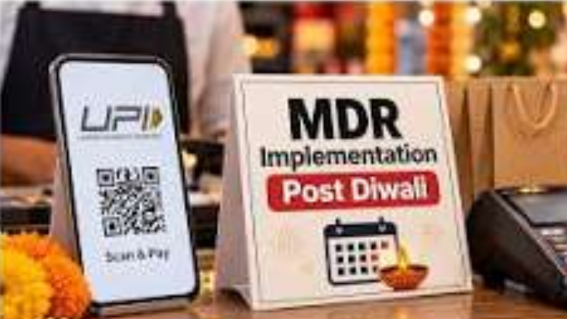
14 October 2026 (Navroze Bureau) The National Payments Corporation of India (NPCI) has postponed the planned implementation of the Merchant Discount Rate (MDR) on selected Unified Payments Interface (UPI) transactions until after Diwali. The new implementation date will be announced separately, giving merchants, banks and payment service providers additional time to prepare for the revised fee structure.
The decision was announced on October 13, just two days before the charges were originally scheduled to take effect on October 15. NPCI said its UPI and Services Steering Committee had decided to delay the rollout while keeping the festive shopping season in mind.
The postponement is temporary and does not mean that the proposed MDR framework has been cancelled. Under the announcement, charges on eligible person-to-merchant (P2M) UPI transactions are expected to be introduced immediately after Diwali, once NPCI notifies the revised date.
What is MDR and why does it matter?
Merchant Discount Rate is a fee associated with processing digital payments. It is generally paid by a merchant to the bank or payment service providers involved in handling a transaction. The fee can affect the cost businesses incur when accepting electronic payments.
UPI has become one of India’s most widely used digital payment systems, allowing customers to transfer money and pay businesses using mobile applications, QR codes and linked bank accounts. Any change to the cost of accepting UPI payments is therefore important for retailers, online sellers, restaurants and other businesses.
The proposed MDR framework concerns only selected merchant transactions. It should not be interpreted as a blanket charge on every UPI payment, and the treatment of individual transactions depends on the eligibility conditions specified in the proposed rules.
Which UPI transactions could attract charges?
Under the proposed framework reported earlier, an MDR of 0.4% was planned for eligible person-to-merchant UPI transactions exceeding ₹2,000. The reported proposal also included a maximum charge of ₹300 for transactions of ₹75,000 and above.
For example, if a ₹10,000 merchant payment falls within the applicable category, a 0.4% MDR would amount to ₹40. However, the actual fee arrangements and who ultimately bears the cost depend on the final applicable rules and agreements.
Person-to-person transfers and merchant payments of up to ₹2,000 were reported as exempt under the proposed structure. Small merchants with monthly UPI transactions of up to ₹1 lakh were also reported to be covered by a proposed exemption. These details should be checked against the final notified framework when NPCI announces the new date.
Why has NPCI delayed the rollout?
The decision comes during the busy festive shopping period, when consumers typically increase spending on clothing, electronics, gifts, travel and household purchases. Retailers and digital payment providers have been seeking clarity about how the proposed charges would work and which transactions would be covered.
Deferring the implementation gives businesses and payment companies more time to understand the rules and prepare their systems. It may also help avoid confusion during a period when digital payments are especially important for merchants and consumers.
Industry concerns have included the possible impact on merchant costs, differences in how transaction categories are treated and the need for clear communication before any new fee becomes applicable. Reports said the proposed rollout had prompted discussions among merchant groups, fintech companies and payment service providers
What does the decision mean for customers and merchants?
For consumers, the announcement does not establish a new immediate charge on all UPI payments. The planned change relates to selected merchant transactions, and NPCI has yet to announce the revised implementation date.
Merchants should watch for the formal notification to understand the transactions covered, the applicable rates and any exemptions. Businesses that accept UPI payments may need to review their payment-provider arrangements once the final details are available.
The delay also gives banks and payment companies additional time to communicate the revised rules to merchants and make any necessary operational changes.
New date awaited after Diwali
NPCI has said the MDR on selected P2M UPI transactions will be implemented immediately after Diwali, with the exact date to be notified separately. As of October 14, no new implementation date had been announced in the reports available.