

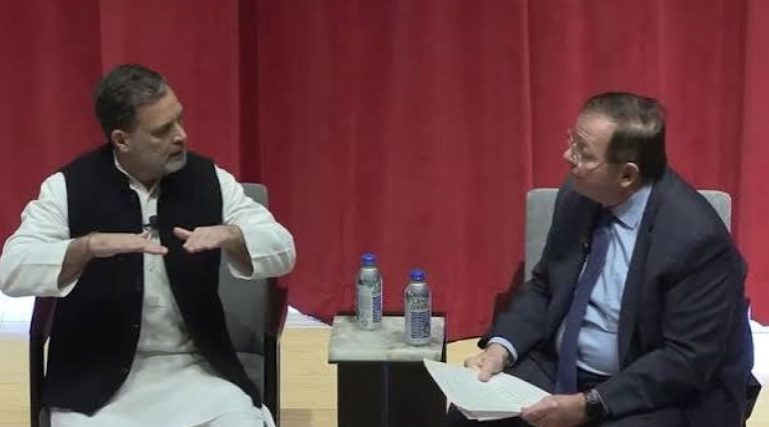
20 November 2026 (Navroze Bureau) Congress leader and Leader of Opposition in the Lok Sabha Rahul Gandhi has said that bilateral talks between India and Pakistan cannot move forward until Islamabad stops supporting and encouraging terrorism against India. He made the remarks during an interaction with students at the University of Chicago in the United States.
Gandhi was responding to a question from a participant who identified himself as a Pakistani national. The participant asked whether India and Pakistan could move beyond mutual accusations and work together for their shared interests.
Responding to the question, Gandhi said there was room for both countries to establish better relations, but Pakistan’s alleged support for terrorism remained a major obstacle.
“There is room, but there is a big problem, which is the support and encouragement of terrorism by Pakistan in our country,” Gandhi said.
He further stated that India could not accept a situation in which innocent citizens continued to lose their lives while diplomatic conversations with Pakistan were taking place.
“It is impossible for us to accept our innocent people being murdered and having a conversation with Pakistan. So the moment that stops, then a conversation can potentially begin,” he added.
Rahul Gandhi’s Response to Pakistani Participant
The exchange took place during an academic interaction at the University of Chicago, where Gandhi discussed India’s foreign policy, international relations, global security and the country’s position in changing geopolitical circumstances.
The question focused on whether the two neighbouring countries could overcome their differences and cooperate for mutual benefit.
Gandhi acknowledged that there was scope for improved relations between India and Pakistan. However, he maintained that the issue of terrorism needed to be addressed before meaningful dialogue could begin.
His remarks reflected the importance of security concerns in determining the future of diplomatic relations between the two countries.
India and Pakistan have experienced several periods of political tension and military confrontation since independence. Relations have frequently been affected by cross-border terrorism, territorial disputes and disagreements over security matters.
The latest comments have once again brought attention to the challenges involved in restarting formal diplomatic engagement between the neighbouring countries.
India-Pakistan Relations and Terrorism
Relations between New Delhi and Islamabad have remained strained for several years. India has repeatedly maintained that terrorism and diplomatic engagement cannot continue simultaneously and has called on Pakistan to take action against terrorist organisations operating from its territory.
Major terror attacks, including the Pathankot, Uri and Pulwama attacks, have further complicated efforts to restore normal relations.
India has consistently raised concerns about cross-border terrorism and its impact on national security. The country has also maintained that Pakistan must demonstrate concrete action against terror networks before meaningful progress can be made in bilateral relations.
Gandhi’s latest statement highlighted that the issue of terrorism remains a significant concern across India’s political spectrum.
His remarks also indicated that the possibility of dialogue should not be completely dismissed, provided the security concerns are addressed.
Gandhi Questions India’s Role in Global Affairs
During the same interaction, Gandhi also expressed concern over India’s position in international diplomacy. He argued that India, given its population, economic potential and geopolitical importance, should play a more active role in global discussions.
Referring to Pakistan’s reported involvement in facilitating negotiations between the United States and Iran, Gandhi questioned why India was not playing a more prominent role in the diplomatic developments.
He described India as having become a “side player” in international affairs and said the country should have a stronger voice in shaping global decisions.
Gandhi also discussed the importance of an independent foreign policy, arguing that India’s international decisions should be guided primarily by its national interests.
He said that maintaining friendships with international leaders was not enough and that countries needed to understand changing geopolitical realities while protecting their own strategic interests.
Discussion on Global Security and Foreign Policy
The interaction was moderated by Professor Robert Pape, a political scientist at the University of Chicago. The discussion covered several international developments, including the Iran conflict, India’s diplomatic position and the changing global security environment.
Gandhi also spoke about the importance of India’s independent approach to international relations. He argued that the emerging global order would involve multiple major powers and civilisations rather than being shaped by a single group of countries.
According to him, India should actively participate in international discussions and contribute to shaping the future global security and economic framework.
He further emphasised that India’s foreign policy should reflect the interests of its large population and the country’s strategic priorities.
Political Significance of the Statement
Gandhi’s comments on Pakistan are significant because they address one of the most sensitive aspects of India’s foreign policy. While political parties may differ on several domestic and international issues, national security and terrorism remain central subjects in discussions concerning India’s relationship with Pakistan.
The Congress leader’s response also attracted attention because it came during an interaction with a Pakistani participant on American soil.
By acknowledging the possibility of future dialogue while making it conditional on an end to terrorism, Gandhi presented his position on the balance between diplomatic engagement and national security.
For now, the future of India-Pakistan relations remains uncertain, with terrorism and longstanding political disagreements continuing to present challenges.
His remarks at the University of Chicago have once again placed the question of bilateral dialogue, regional security and India’s role in international diplomacy at the centre of political discussion.