

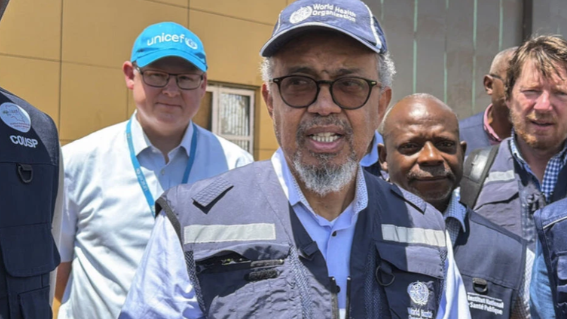
25 November 2026 (Navroze Bureau) The World Health Organization (WHO) has confirmed the safe evacuation of its staff and other healthcare workers from a hospital in the Democratic Republic of Congo (DR Congo) after they spent more than three days sheltering from intense fighting in the region.
WHO Director-General Tedros Adhanom Ghebreyesus announced on Tuesday, November 24, that personnel from the global health agency, the DR Congo Ministry of Health and other humanitarian organisations had been evacuated from a hospital in Akwe, located in Ituri province.
The healthcare workers had been trapped inside the hospital amid fierce clashes in the surrounding area. The evacuation was carried out under extremely challenging circumstances through coordinated efforts involving health authorities, government representatives and humanitarian partners.
The development comes at a critical time for the country, which is dealing with a major Ebola outbreak caused by the Bundibugyo virus. Rising insecurity and armed violence in eastern DR Congo have increasingly disrupted medical services and efforts to control the spread of the disease.
WHO Chief Confirms Successful Evacuation
Tedros Adhanom Ghebreyesus shared the evacuation update through a social media post, expressing gratitude to everyone involved in bringing the trapped healthcare workers to safety.
He confirmed that WHO personnel, officials from the Congolese Health Ministry and other colleagues had successfully left the hospital after sheltering there for more than three days.
The WHO chief acknowledged that the operation had taken place under very difficult security conditions.
He also reiterated the importance of protecting healthcare facilities, medical professionals, Ebola response teams and humanitarian workers during armed conflicts.
The evacuation brought relief to the international health community, which has been closely monitoring the deteriorating security situation in eastern DR Congo.
Ebola Response Team Temporarily Relocated
Alongside confirming the evacuation, Tedros announced that WHO had temporarily relocated its Ebola response team from Mongbwalu because of increased insecurity.
The decision was taken to protect the lives of medical personnel and humanitarian workers operating in the affected region.
The team will remain away from the area until the security situation improves sufficiently for operations to resume safely.
The temporary relocation is expected to create additional challenges for the Ebola response, particularly in areas where medical assistance, disease surveillance and contact tracing are urgently needed.
WHO has repeatedly warned that attacks and insecurity are seriously affecting efforts to contain the outbreak.
Heavy Fighting Forces Healthcare Workers to Take Shelter
The situation became critical over the weekend when heavy fighting erupted near a hospital in Ituri province.
According to earlier statements from Tedros, WHO personnel and their humanitarian partners were forced to take shelter inside the hospital’s maternity ward as clashes continued nearby.
The workers had been sheltering for more than 24 hours when the WHO chief first reported the incident on Sunday.
The fighting created serious risks for patients, their families, doctors, nurses and emergency response personnel. Hospital operations were also disrupted, making it difficult for medical teams to continue providing essential services.
Tedros warned that increasing attacks across eastern DR Congo since late October had significantly affected the country’s Ebola response.
The situation has raised concerns about the safety of medical facilities in conflict-affected areas, where healthcare workers are already facing difficult conditions.
DR Congo Faces a Serious Ebola Outbreak
The evacuation comes as DR Congo continues to battle one of its most serious Ebola outbreaks.
According to WHO figures, the country has recorded 11,762 confirmed cases and 5,775 deaths in the outbreak, making it the country’s worst-ever Ebola crisis.
The outbreak was declared in May 2026 and has spread across several regions, particularly in the eastern and northeastern parts of the country.
Ituri province remains the epicentre of the outbreak, accounting for a significant proportion of infections and deaths.
The Bundibugyo strain responsible for the outbreak is particularly concerning because there are currently no approved vaccines or specific treatments available for it.
Healthcare authorities are facing difficulties identifying infections, monitoring suspected cases and ensuring that patients receive timely medical attention.
The ongoing violence has further complicated these efforts by limiting access to affected communities.
Violence Creates Additional Challenges for Humanitarian Organisations
Eastern DR Congo has experienced decades of armed conflict involving different armed groups. The violence has repeatedly displaced communities and disrupted essential public services.
Recent attacks have increased pressure on humanitarian organisations working to provide healthcare, food assistance and emergency support.
The security situation is particularly concerning for Ebola response teams because their work requires regular access to communities, hospitals and suspected infection locations.
Contact tracing, testing and patient isolation are essential parts of controlling an Ebola outbreak. However, these activities become extremely difficult when healthcare workers cannot safely travel to affected areas.
The United Nations and international humanitarian organisations have repeatedly called for the protection of civilians, medical personnel and healthcare infrastructure.
According to a United Nations report, the WHO has verified more than 87 attacks on healthcare facilities and personnel in DR Congo since January 2026.
Vaccine Development Offers Some Hope
Despite the difficult situation, international health organisations are continuing efforts to develop vaccines against the Bundibugyo strain.
Two candidate vaccines are expected to enter clinical trials in Ituri province.
One candidate, ChAdOx1, was developed by the University of Oxford in collaboration with India’s Serum Institute of India.
The second candidate, known as mRNA-1469, was developed by US-based pharmaceutical company Moderna using messenger RNA technology.
Gavi, the Vaccine Alliance, has also announced an advance purchase commitment with the Serum Institute of India and Serum Life Sciences to secure access to up to 1.5 million doses of the ChAdOx1 vaccine, provided the clinical trials are successful and the vaccine receives regulatory approval.
These developments could become important steps towards controlling the outbreak. However, vaccine availability and successful clinical trials remain essential before the candidates can be used more widely.
WHO Calls for Protection of Medical Personnel
The WHO has stressed that healthcare workers, patients, hospitals and humanitarian organisations must remain protected even during armed conflicts.
The successful evacuation of personnel from Akwe represents an important achievement for humanitarian partners working in the region.
However, the temporary relocation of the Ebola response team highlights the continuing difficulties faced by medical organisations.
The immediate priority remains ensuring the safety of healthcare workers while maintaining essential medical support for affected communities.
As fighting continues to threaten humanitarian operations, international organisations face the difficult task of balancing staff safety with the urgent need to control the Ebola outbreak.
The coming days will be crucial in determining whether medical teams can safely return to affected areas and resume their work.