

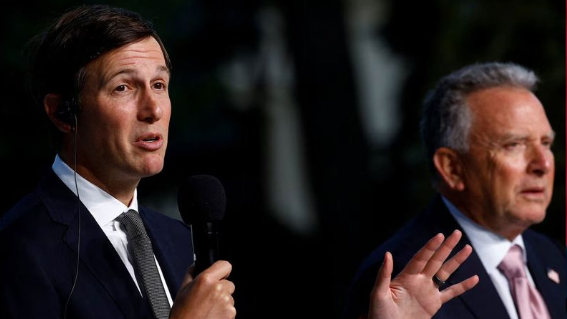
26 November 2026 (Navroze Bureau) US special envoy Jared Kushner has urged Israel to move away from what he described as a “constant wartime mindset” and focus more on economic diplomacy, regional cooperation and long-term stability in the Middle East. His remarks come amid growing differences between the administration of US President Donald Trump and Israeli Prime Minister Benjamin Netanyahu over the future of Gaza and the implementation of Washington’s post-war peace plan.
Kushner made the comments during an interview with German businessman Mathias Döpfner on the MD Meets podcast, released on Wednesday. He argued that Israel should focus on building stronger economic relationships with other countries instead of allowing military and security concerns to dominate its regional policy.
The US envoy also warned that Israel risks becoming increasingly isolated internationally if it fails to change its approach towards Gaza. His comments reflect Washington’s growing push for reconstruction, demilitarisation and a new administrative arrangement for the Palestinian territory.
Kushner Warns Israel Against International Isolation
During the interview, Kushner repeated concerns he had previously expressed in an article published in New York Magazine. He warned that Israel could move towards becoming a “global pariah” if it failed to reconsider its policies towards Gaza and its broader international relationships.
He argued that Israel has a strong economy, advanced technology and considerable business potential but needs to communicate the benefits of partnering with the country more effectively.
Kushner compared Israel’s approach with that of Saudi Arabia and the United Arab Emirates. He pointed out that representatives from these Gulf countries often visit Washington with large business delegations and focus on signing commercial agreements.
“When the Saudis or the Emiratis come to Washington, they bring 100 businessmen, and they’re signing deals,” Kushner said.
He suggested that Israel should adopt a similar approach by prioritising international business partnerships, investment opportunities and economic cooperation.
Gaza Reconstruction Central to US Peace Plan
A major part of Kushner’s remarks focused on the future of Gaza, which has faced extensive destruction during the conflict.
He argued that reconstruction should not simply involve restoring buildings and infrastructure to their previous condition. Instead, he suggested using the opportunity to develop a different economic and infrastructure model for the territory.
“The good thing about the war is that Gaza does need to be built. So why build it into what it was? Let’s build it into something new,” he said.
Kushner also stressed that Gaza’s reconstruction must be connected to its demilitarisation and the removal of weapons from armed groups.
Under the Trump administration’s proposed 20-point framework, Gaza would eventually be governed by a Palestinian technocratic administration instead of Hamas.
The proposal also involves an international stabilisation force and arrangements to ensure that security responsibilities are transferred through a phased and verifiable process.
Kushner said Israel needed confidence that the disarmament process would actually be implemented and that international mechanisms would verify progress.
He argued that reconstruction could create opportunities for Palestinians while also addressing Israel’s security concerns.
Kushner Proposes Economic Cooperation With Egypt
The US envoy also highlighted the importance of regional economic partnerships, particularly between Israel and Egypt.
He proposed exploring joint data centre and energy projects in Egypt’s Sinai Peninsula once the Gaza situation is resolved.
According to Kushner, such projects could create economic opportunities, attract investment and strengthen cooperation between countries in the region.
He suggested that economic partnerships could help transform diplomatic agreements into practical benefits for businesses and ordinary people.
His proposal also reflects the broader economic approach associated with the Abraham Accords, which established diplomatic relations between Israel and several Arab countries during Trump’s first presidential administration.
Kushner believes that regional cooperation could provide a foundation for more sustainable relationships and reduce the region’s dependence on recurring military confrontations.
Comments on Netanyahu and Israel’s Political Situation
Kushner also discussed his relationship with Israeli Prime Minister Benjamin Netanyahu and the challenges facing the implementation of the Gaza plan.
Asked whether former Israeli war cabinet member Gadi Eisenkot could be a more cooperative partner in advancing Washington’s proposals, Kushner avoided directly endorsing any political alternative.
He acknowledged that Eisenkot had made positive comments about making Gaza a priority.
However, Kushner pointed out that Netanyahu had previously supported the proposed framework and remained capable of implementing it.
He also acknowledged that dealing with Netanyahu was not always straightforward, although he described their conversations as productive.
Kushner said that whoever becomes Israel’s next prime minister would eventually have to make the Gaza issue a priority because there was no other alternative.
Israel’s political situation and recent elections have reportedly slowed progress on the implementation of the proposed arrangements.
Kushner Discusses Palestinian Leadership and Two-State Solution
The US envoy also addressed the challenges surrounding Palestinian leadership and the possibility of a long-term political settlement.
He argued that meaningful reform of Palestinian leadership would be necessary before a stable political arrangement could emerge.
Kushner criticised both the Palestinian Authority and Hamas, describing the Palestinian Authority as ineffective and corrupt while identifying Hamas as a terrorist organisation.
He also acknowledged the deep mistrust among Israelis following the October 7, 2023, Hamas attacks.
According to Kushner, many Israelis have lost confidence in the possibility of peace with Palestinians.
At the same time, he indicated that there are Palestinians who want peace and that an appropriate political and administrative framework needs to be established.
The proposed Palestinian technocratic administration is intended to provide an alternative governing structure for Gaza and support its reconstruction.
Iran Conflict Also Features in Kushner’s Remarks
Apart from Gaza, Kushner also discussed tensions involving Iran and the wider Middle East.
His comments came as Netanyahu continued seeking support from the Trump administration for a tougher approach towards Tehran, including the possibility of renewed military action.
Kushner said that President Trump continued to keep all options available regarding Iran.
He also criticised European countries for what he described as their limited support for Washington during the confrontation with Tehran.
The remarks highlight the different diplomatic and security challenges facing the Trump administration across the Middle East.
Economic Diplomacy Becomes a Key Message
Kushner’s latest comments indicate that Washington wants Israel to place greater emphasis on economic partnerships, regional development and the implementation of the Gaza reconstruction framework.
His message also reflects the administration’s broader effort to move beyond military confrontation and establish a regional arrangement involving security guarantees, Palestinian governance and international investment.
However, several major challenges remain, particularly regarding Hamas’s disarmament, Israeli security concerns, Palestinian political representation and the practical implementation of reconstruction plans.
For now, Kushner is urging Israel to combine its security priorities with economic diplomacy and stronger international engagement, arguing that long-term regional stability will require more than military measures.