

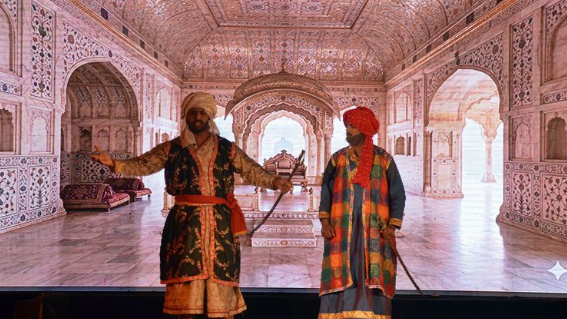
27 November 2026 (Navroze Bureau) Amritsar’s remarkable journey of 450 years, shaped by faith, sacrifice, culture and resilience, has come alive on stage through a grand theatrical production titled ‘Dastaan-e-Amritsar’. Presented at Guru Nanak Dev University (GNDU), the light-and-sound production takes audiences through the city’s rich history, from its foundation by Sri Guru Ram Das to significant events of the freedom struggle, including the Jallianwala Bagh massacre.
The production was organised as part of celebrations marking the 450th anniversary of Amritsar. Staged at the university’s Dasmesh Auditorium, it emerged as a major attraction during the two-day celebrations. The nearly one-hour-and-45-minute performance brought together important chapters from the city’s spiritual, political, literary and social history.
Conceived as part of Professor Karamjeet Singh’s Global Conclave initiative, the production was developed by noted playwright and theatre director Kewal Dhaliwal. It was presented by Manch-Rangmanch, using theatre, music, visuals and performances to narrate the evolution of one of Punjab’s most historically significant cities.
A journey through Amritsar’s spiritual history
The narrative begins with the foundation of Amritsar and highlights the contributions of Sikh Gurus who played a central role in shaping its spiritual identity. The lives and contributions of Sri Guru Ram Das, Sri Guru Arjan Dev and Sri Guru Hargobind Sahib form an important part of the theatrical presentation.
The production also highlights the historical association of Sai Mian Mir with the city, along with the martyrdom of Baba Deep Singh. These episodes reflect Amritsar’s religious significance and its long-standing traditions of faith, devotion and sacrifice.
Stories associated with Bibi Rajni, Bhai Mani Singh, Sukha Singh and Mehtab Singh have also been included. Through these accounts, the production presents different dimensions of the city’s history and the individuals whose lives became part of its collective memory.
Jallianwala Bagh and the freedom struggle
A major part of ‘Dastaan-e-Amritsar’ focuses on the city’s contribution to India’s freedom movement. The Jallianwala Bagh massacre, one of the darkest chapters in India’s colonial history, is presented as a powerful reminder of the sacrifices made during the struggle against British rule.
The production also highlights the contributions and sacrifices of several freedom fighters, including Madan Lal Dhingra, Mewa Singh Lopoke, Baba Gurdit Singh, Sohan Singh Bhakna and Shaheed Udham Singh.
By bringing these historical personalities and events to the stage, the production connects Amritsar’s local history with the wider story of India’s struggle for independence. It also underlines the city’s association with resistance, courage and the fight against injustice.
Beyond monuments: The everyday character of Amritsar
The theatrical presentation goes beyond major historical events and religious landmarks. It also explores the everyday life and cultural identity of Amritsar, including its traditional markets located within the city’s 12 historic gates.
Old newspapers, educational institutions and places of worship belonging to different communities have been included to portray the city’s diverse social landscape. Temples, mosques and churches feature in the narrative, reflecting Amritsar’s traditions of cultural coexistence.
Speaking about the research behind the production, Kewal Dhaliwal said considerable effort had gone into presenting historical details accurately. He explained that the team had researched the city’s heritage and traditions to ensure that the production reflected the history that shaped generations of Amritsar’s residents.
Dhaliwal has previously worked on theatrical productions based on major historical episodes, including Jallianwala Bagh and Saragarhi. His experience in presenting historical narratives through theatre has contributed to the scale and approach of ‘Dastaan-e-Amritsar’.
Amritsar’s literary and cultural legacy
The production also celebrates the city’s contribution to Punjabi literature and intellectual life. The works and legacy of writers such as Bhai Vir Singh, Dhani Ram Chatrik, Nanak Singh and Saadat Hasan Manto are included in the presentation.
It also recognises the humanitarian contribution of Bhagat Puran Singh and his work at Pingalwara, which remains an important part of Amritsar’s social history.
The city’s cultural landscape is further represented through references to Punjab Naatshala, Virsa Vihar, traditional cuisine, festivals and kite-flying at Gol Bagh. These elements bring attention to the customs, artistic traditions and everyday experiences that have helped define Amritsar over generations.
Theatre as a way to preserve heritage
Professor Karamjeet Singh said the production transforms history from a collection of dates and events into a living narrative. By placing sacred landmarks alongside neighbourhoods, literary figures and everyday cultural traditions, the presentation highlights how a city’s heritage is preserved not only through its monuments but also through its people and shared experiences.
‘Dastaan-e-Amritsar’ offers audiences an opportunity to understand the city through multiple perspectives. Its combination of historical episodes, music, visuals and dramatic performances brings together different periods of Amritsar’s development in one theatrical experience.
As the city marks 450 years of its history, the production serves as a cultural tribute to the people, personalities and events that have shaped its identity. From the spiritual foundations laid by Guru Ram Das to the sacrifices at Jallianwala Bagh and the contributions of writers, artists and social reformers, the performance presents Amritsar as a city whose heritage continues to influence its present.
The production also reinforces the importance of documenting and sharing local history with younger generations, ensuring that the stories behind the city’s landmarks and traditions remain part of public memory.