

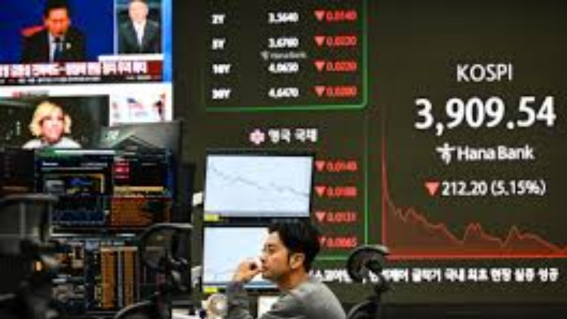
2 February 2026 (Navroze Bureau) : Asian equity markets witnessed a sharp sell-off on Tuesday as investor sentiment weakened following renewed jitters around artificial intelligence (AI) stocks on Wall Street. The technology-led downturn spilled over into regional markets, with South Korea’s benchmark KOSPI index plunging nearly 5%, marking one of its steepest single-day declines in recent months.
The sell-off reflected growing concerns that the global rally driven by AI optimism may be losing momentum, prompting investors to reassess valuations, especially in technology-heavy markets across Asia.
Wall Street AI Concerns Spill Over to Asia
The slump in Asian markets followed a volatile session on Wall Street, where major U.S. indices closed sharply lower amid profit-booking in AI-linked stocks. Investors grew wary of stretched valuations, slowing earnings momentum, and increasing regulatory scrutiny around advanced technologies.
Large-cap technology and semiconductor stocks bore the brunt of selling, triggering a broader risk-off mood globally. Since many Asian markets are closely tied to the global technology supply chain, the weakness in U.S. tech stocks quickly translated into heavy losses across the region.
Market analysts said fears of an AI-driven bubble, combined with uncertainty over future earnings growth, prompted investors to reduce exposure to high-growth stocks and move toward safer assets.
KOSPI Leads Regional Losses
South Korea’s KOSPI index emerged as the worst performer in Asia, tumbling around 5% during the session. The sharp decline was driven by heavy selling in major technology and semiconductor stocks, which form a significant portion of the index.
Shares of leading chipmakers and electronics firms fell steeply as concerns mounted over potential moderation in global demand for AI-related hardware. South Korea’s economy is heavily dependent on exports of semiconductors, making its stock market particularly sensitive to shifts in global tech sentiment.
Analysts noted that foreign institutional investors were net sellers, exacerbating the decline. “The KOSPI is highly exposed to global technology cycles. Any cooling in AI enthusiasm has an outsized impact,” said a regional market strategist.
Broader Asian Market Weakness
Other Asian markets also ended sharply lower. Japan’s Nikkei 225 slipped significantly as technology and export-oriented stocks came under pressure. Taiwan’s benchmark index declined amid losses in semiconductor shares, while Hong Kong and mainland Chinese markets also traded in the red.
In Southeast Asia, markets such as South Korea, Singapore, and Taiwan saw heightened volatility, reflecting concerns about slowing global growth and reduced appetite for risk assets.
Investors across the region adopted a cautious stance, with trading volumes rising as portfolios were rebalanced away from high-risk sectors.
AI Optimism Faces Reality Check
For much of the past year, AI-related stocks have been at the forefront of global market rallies, driven by expectations of rapid technological adoption and long-term productivity gains. However, recent sessions suggest that investors are beginning to question whether current valuations fully reflect near-term earnings realities.
Market experts point out that while AI remains a transformative technology, revenue growth may take longer to materialize than initially expected. Rising costs, supply chain constraints, and intense competition are also weighing on margins.
“The narrative hasn’t changed, but expectations are being reset,” said a technology sector analyst. “Markets are realizing that AI adoption is a long-term story, not a straight-line growth trajectory.”
Global Factors Add to Pressure
Apart from AI concerns, several macroeconomic factors contributed to the sell-off. Persistent uncertainty over global interest rates, geopolitical tensions, and uneven economic data have made investors more risk-averse.
In the U.S., signals that interest rates could remain higher for longer have pressured growth stocks, which are more sensitive to borrowing costs. A stronger dollar has also weighed on emerging Asian markets by increasing capital outflows and raising import costs.
Additionally, caution ahead of key global economic data releases has encouraged investors to reduce exposure to volatile assets.
Investor Sentiment Turns Defensive
The sharp fall in Asian markets reflects a broader shift toward defensive positioning. Investors moved funds into traditional safe-haven assets such as government bonds and gold, while equities—especially technology stocks—faced selling pressure.
Volatility indicators across Asian markets spiked, suggesting heightened nervousness among traders. Analysts warned that markets could remain choppy in the near term as investors digest mixed signals from earnings, policy outlooks, and technological trends.
What Lies Ahead
Despite the sharp correction, experts caution against reading the sell-off as the end of the AI theme. Many believe the current decline represents a consolidation phase after a strong rally rather than a structural downturn.
“Corrections are a natural part of any bull cycle,” said a portfolio manager. “The key question is whether earnings growth can catch up with expectations. That will determine the next leg of the market.”
In the near term, Asian markets are expected to remain sensitive to movements in U.S. tech stocks, central bank signals, and corporate earnings updates. Investors are likely to remain selective, focusing on companies with strong fundamentals and clearer revenue visibility.
Conclusion
The sharp tumble in Asian stocks, led by a 5% plunge in South Korea’s KOSPI, underscores how quickly global sentiment can shift when confidence in a dominant investment theme weakens. While AI remains a powerful long-term driver, recent market action suggests investors are becoming more cautious, reassessing risks amid uncertain global conditions.
As volatility persists, market participants are bracing for further swings, with attention firmly fixed on Wall Street cues and the evolving outlook for the global technology sector.
Summary:
Asian stocks fell sharply amid AI-related jitters from Wall Street, with South Korea’s KOSPI plunging 5%, as investors reassessed tech valuations and shifted to a cautious, risk-off stance.