

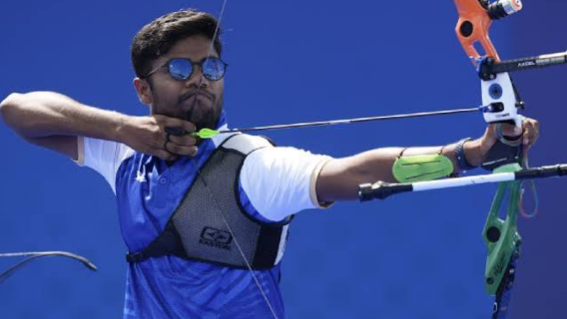
16 October 2026 (Navroze Bureau) Indian archer Dhiraj Bommadevara has offered an insight into the mental discipline required to perform at the highest level, explaining how athletes try to maintain their focus and execute their shots even when they are physically uncomfortable or mentally under pressure. His reflections highlight the importance of entering the right competitive “zone” in a sport where a small mistake can decide the outcome.
Bommadevara, one of India’s leading recurve archers, has represented the country on major international stages, including the Paris 2024 Olympic Games. His experiences have taught him that archery is not simply about physical strength or technical ability. Consistency, concentration and the ability to follow a practiced routine under pressure are equally important.
The question at the heart of his discussion is whether an archer can still deliver a perfect shot when conditions are far from ideal. By asking whether he could hit 10s at the Olympics even if he were ill, Bommadevara points to the demanding standard elite athletes set for themselves: being able to rely on preparation rather than waiting for everything to feel perfect.
What does the ‘zone’ mean in archery?
In archery, being in the “zone” refers to a state of concentration in which an athlete is fully focused on the shot and able to execute the movements developed through training. The archer must control breathing, posture, release and follow-through while managing distractions and competitive pressure.
Unlike sports in which players can continuously react to opponents, recurve archery requires athletes to repeat a highly precise sequence for every arrow. Wind, nerves, physical discomfort and the importance of the moment can all affect performance.
Bommadevara’s approach centres on trusting the process built during practice. Rather than allowing the score or pressure to dominate his thoughts, an archer needs to concentrate on the actions within their control. This ability to repeat a familiar routine is particularly important at the Olympics, where even experienced competitors can feel the weight of representing their country.
Why team bonding matters in an individual sport
Although archery is often considered an individual discipline, team events require athletes to trust one another and work together under pressure. A teammate’s performance can influence the atmosphere, confidence and decision-making of the entire group.
Bommadevara has highlighted team bonding as an important part of Indian archery, recognising that relationships between teammates can affect how effectively they perform together. Maintaining that connection is especially important when athletes face setbacks or struggle to find their best form.
A strong team environment can help athletes communicate openly, manage disappointment and return their attention to the next shot. In a competition where each arrow matters, the ability to remain composed and support teammates can be as valuable as technical preparation.
Lessons from the Paris Olympics
Bommadevara’s performance at the Paris 2024 Olympics demonstrated both the precision required in elite archery and the narrow margins that can separate victory from defeat.
In the men’s individual competition, he lost a second-round shoot-off against Canada’s Eric Peters despite both archers hitting a 10. Peters advanced because his arrow landed closer to the centre of the target. Bommadevara’s arrow was 2.4 centimetres farther from the centre.
The result showed that even an excellent shot does not always guarantee victory. Archers must combine technical accuracy with the ability to handle uncertainty and recover emotionally from difficult moments.
For Bommadevara, experiences at major tournaments provide lessons that can be carried into future competitions. Consistent practice, preparation for high-pressure situations and the ability to focus on execution remain central to his development.
Preparing to perform when conditions are difficult
Elite athletes cannot always control how they feel on competition day. They may experience nervousness, fatigue or uncomfortable conditions, but their preparation is designed to help them perform as consistently as possible.
The challenge is to avoid becoming distracted by circumstances and instead return attention to the next action. In archery, that means following the same technical sequence, maintaining concentration and making adjustments when conditions require them.
Bommadevara’s reflections underline a broader lesson about elite sport: confidence is not simply believing that everything will go well. It also comes from knowing that an athlete has practised enough to respond when things do not go according to plan.