

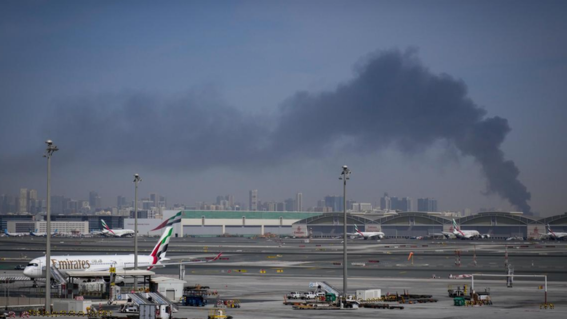
2 March 2026 (Navroze Bureau) : The long-standing image of Dubai as a secure, tax-free sanctuary for investors and expatriates has been shaken following reports of blasts linked to Iranian airstrikes amid escalating regional tensions.
For decades, Dubai has marketed itself as a politically stable, business-friendly hub insulated from the volatility often associated with Middle East conflicts. Its strategic location, world-class infrastructure, and absence of personal income tax have attracted multinational corporations, high-net-worth individuals, and millions of foreign workers. However, the recent explosions — reportedly connected to military escalation involving Iran — have unsettled residents and global investors alike.
Authorities in the United Arab Emirates have not confirmed significant structural damage or mass casualties, but the psychological impact of the incident has been immediate. Social media videos showing distant flashes and the sound of blasts circulated rapidly, fueling speculation and concern.
Analysts note that while the UAE has historically maintained a delicate diplomatic balance in regional geopolitics, it remains geographically close to flashpoints. Any direct or indirect spillover from broader conflicts poses reputational risks for cities like Dubai that depend heavily on perceptions of stability.
Dubai’s economy is deeply intertwined with global capital flows. Its real estate market, financial services sector, and tourism industry rely on investor confidence. Even temporary security scares can trigger short-term volatility, particularly in sensitive sectors such as property and aviation.
Financial experts suggest that markets may react cautiously in the immediate term, with some investors adopting a wait-and-watch approach. However, they also emphasize that Dubai has demonstrated resilience in the past, recovering swiftly from global financial crises, pandemic-related disruptions, and regional instability.
The emirate’s leadership has consistently positioned Dubai as a neutral commercial gateway rather than a political actor. Major multinational firms continue to operate regional headquarters from the city, and expatriates make up nearly 90 percent of the population.
Security measures across the UAE were reportedly heightened following the blasts. Airports, seaports, and key infrastructure installations have reinforced surveillance and defense coordination. Authorities have urged residents to rely on official updates and avoid spreading unverified information.
Geopolitical observers argue that even isolated incidents can reshape international narratives. Dubai’s appeal has always rested not only on economic incentives but also on the perception that it exists in a protective bubble despite regional turbulence. Any breach of that perception — however limited — carries symbolic weight.
Real estate developers and business councils have reassured stakeholders that operations remain normal. Tourism activities continue, and commercial centers are functioning without disruption. Aviation authorities have not announced large-scale flight suspensions, though airspace monitoring remains tight.
Meanwhile, diplomatic channels are reportedly active as regional players attempt to prevent further escalation. The broader concern among policy analysts is that prolonged instability could alter capital movement patterns across the Gulf.
Despite the uncertainty, experts caution against overreaction. Historically, markets tend to differentiate between sustained conflict and isolated incidents. Dubai’s diversified economy — spanning logistics, trade, technology, hospitality, and finance — provides a buffer against temporary shocks.
Still, the episode serves as a reminder that no global hub is entirely insulated from geopolitical realities. As tensions in the region evolve, Dubai’s ability to maintain investor trust and security credibility will be closely watched.
For residents and businesses, the immediate focus remains on safety and continuity. For global investors, the key question is whether the blasts represent a one-off incident or the beginning of a broader shift in regional risk dynamics.
Dubai’s leadership now faces the challenge of reaffirming its status as a safe haven in an increasingly uncertain geopolitical climate.
Summary
Blasts linked to Iranian airstrikes have shaken Dubai’s reputation as a secure, tax-free haven. While operations continue normally, investor confidence and regional stability concerns remain under close watch.