

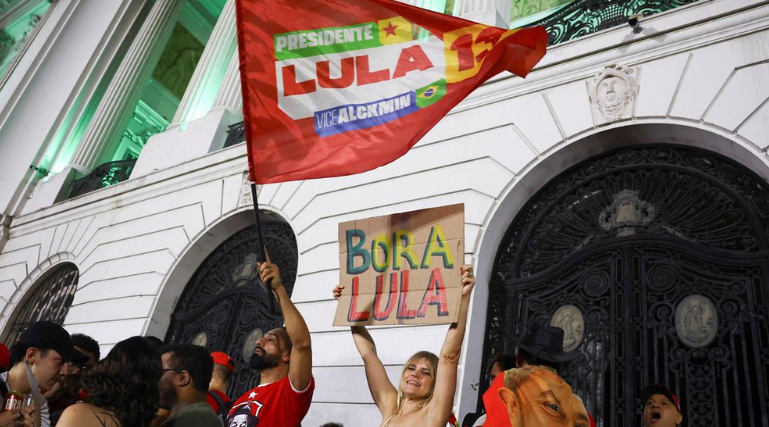
5 October 2026 (Navroze Bureau) Brazil’s presidential election is heading for a runoff after Flavio Bolsonaro finished ahead of incumbent President Luiz Inacio Lula da Silva in the first round but failed to secure the majority required for an outright victory. The result sets up a closely watched second-round contest between the son of former President Jair Bolsonaro and the veteran left-wing leader.
With almost all polling stations counted, Flavio Bolsonaro received around 56.1 million votes, equivalent to roughly 47% of valid votes, while Lula secured about 53.9 million votes, or approximately 45%. The second round is scheduled for October 25.
The result came as a surprise compared with several opinion polls released before voting day. Surveys had generally shown Lula with a narrow lead or the two candidates running close together. Flavio’s stronger-than-expected first-round performance allowed him to finish narrowly ahead of the incumbent and enter the runoff with the highest vote share.
Flavio Bolsonaro, 45, is a senator from Rio de Janeiro and the son of former President Jair Bolsonaro. He is running for Brazil’s presidency for the first time. His campaign has sought to build on the political movement associated with his father while focusing on issues including the economy, public security and opposition to Lula’s Workers’ Party.
Lula, 80, is seeking another term after returning to the presidency in 2023. He previously served as president from 2003 to 2010 and is now seeking a fourth non-consecutive term. His campaign has highlighted his administration’s social programmes and previous record in government.
The first-round result means neither candidate crossed the 50% threshold required to win the presidency outright. Brazil’s electoral system sends the two leading candidates into a second round when no presidential contender receives more than half of valid votes.
The October 25 runoff will now give both campaigns several weeks to reach voters who supported candidates eliminated in the first round. Several other candidates received smaller shares of the vote, meaning their supporters could become important in the second round.
Among the other candidates, Augusto Cury finished third with around 2.9% of valid votes, followed by Renan Santos and Ronaldo Caiado. The field included 12 presidential candidates, but none came close to the two leading contenders.
The campaign has been dominated by concerns over the cost of living, crime, corruption, government spending and Brazil’s economic direction. Inflation and household financial pressures have remained important issues for voters, while public security has also featured prominently in political debate.
Brazil’s fiscal position is another issue likely to remain important during the runoff. Government spending and public debt have generated concern among investors and economists, placing economic management among the major challenges facing the next administration.
The election is also being closely followed outside Brazil because of the country’s importance as Latin America’s largest economy. Brazil maintains major economic relationships with the United States, China and other global powers, meaning the outcome could influence trade, diplomacy and regional politics.
Flavio Bolsonaro’s political rise has also brought renewed attention to the broader Bolsonaro family. His father, Jair Bolsonaro, remains a major figure among supporters of Brazil’s political right. The former president has faced major legal and political challenges in recent years.
The younger Bolsonaro has sought to position himself as the political successor to his father. His first-round performance demonstrated that the Bolsonaro political movement retains substantial support, although the final result will depend on the second-round contest.
Lula’s campaign, meanwhile, faces the challenge of expanding its support beyond the voters who backed him in the first round. The president has indicated that the runoff will provide an opportunity to present the differences between the candidates and their proposals.
The runoff is expected to intensify an already polarised political debate. Both candidates will have to appeal to voters who did not support them in the first round while attempting to maintain their existing bases.
The election process has also drawn attention because of Brazil’s electronic voting system, which has been used extensively in the country’s elections. Election authorities have reported that voting proceeded without major disruptions.
The first-round result also produced significant gains for candidates associated with the political right in congressional and state-level contests, according to election reports. This could influence the political environment facing the next president regardless of who wins the presidency.
For financial markets, the result has attracted attention because investors are closely monitoring the candidates’ economic positions, fiscal plans and approach to public spending. The prospect of a change in political leadership could affect expectations surrounding Brazil’s currency, bonds and equities.
However, the presidential contest is not yet decided. Flavio Bolsonaro’s first-round lead gives him the highest vote share entering the runoff, while Lula remains within a relatively narrow distance of his opponent. The final outcome will be determined by the October 25 vote.
The coming weeks will therefore be crucial for both campaigns. They will focus on winning over undecided voters, building alliances and presenting their economic and social agendas to the electorate.
Brazil’s presidential race has now entered its decisive stage, with Flavio Bolsonaro and Lula preparing for a direct contest. The first-round result overturned several pre-election expectations, but the October 25 runoff will determine who leads Latin America’s largest economy for the next presidential term.