

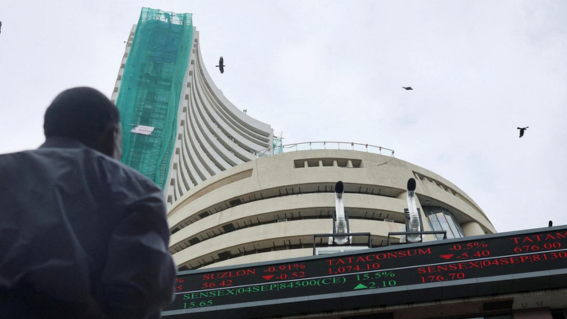
19 January 2026: Indian equity benchmarks opened on a weak note in early trade, with Sensex and Nifty slipping into the red, weighed down by selling pressure in heavyweight stocks such as Reliance Industries and ICICI Bank. The decline reflected cautious investor sentiment amid mixed global cues and concerns over near-term market valuations.
From the opening bell, both indices showed signs of weakness as profit-booking emerged across key sectors. Market participants noted that after a recent rally, investors appeared to be locking in gains, particularly in blue-chip stocks that had seen strong upward movement in previous sessions. The pressure on heavyweights had an outsized impact on benchmark indices due to their significant weightage.
Reliance Industries, one of the largest constituents of the Sensex and Nifty, traded lower in early hours as investors turned cautious on large-cap stocks. Similarly, ICICI Bank witnessed selling pressure, dragging down the banking pack and contributing to the broader market decline. Other frontline stocks also showed weakness, reinforcing the negative mood on Dalal Street.
The broader market sentiment was influenced by mixed global cues. Asian markets traded with caution as investors awaited further clarity on global interest rate direction, inflation trends, and economic data from major economies. U.S. markets had ended the previous session with modest movement, offering limited direction to domestic investors.
Sectorally, banking and financial stocks were among the top laggards in early trade. Apart from ICICI Bank, other private sector banks and select financial institutions also witnessed mild to moderate losses. Market analysts noted that the financial sector, which has led much of the recent rally, is now seeing intermittent profit-taking.
The energy sector also remained under pressure, largely due to weakness in Reliance Industries. Since the stock carries significant weight in benchmark indices, its decline had a notable impact on overall market performance. Some metal and auto stocks also traded in the red, reflecting broader caution across cyclical sectors.
On the positive side, select pockets of the market showed resilience. A few IT and FMCG stocks managed to trade marginally higher, supported by defensive buying. Investors often rotate into relatively stable sectors during periods of uncertainty, which explains the limited support seen in these segments. However, the gains were not strong enough to offset losses in heavyweight stocks.
Market experts attributed the early decline to a combination of profit-booking, cautious global sentiment, and valuation concerns. After a sustained upward move over recent weeks, valuations in certain segments had become stretched, prompting short-term traders to book profits. Institutional investors were also seen adopting a wait-and-watch approach ahead of key economic data releases.
Another factor weighing on sentiment was uncertainty around foreign fund flows. Foreign institutional investors (FIIs) have played a crucial role in recent market movements, and any signs of slowdown in inflows tend to trigger caution among domestic investors. While there has been no sharp reversal, even mild hesitation from global investors can affect near-term market direction.
Despite the weak opening, analysts cautioned against reading too much into early trade movements. Markets often witness volatility during the first few hours, especially when global cues are mixed. Several experts believe that the broader trend remains constructive as long as key technical support levels hold.
The performance of mid-cap and small-cap stocks was relatively mixed. Some stocks in these segments managed to attract buying interest, especially those supported by strong company-specific fundamentals. However, overall sentiment in the broader market remained subdued, reflecting the cautious tone seen in frontline indices.
Investors are also closely tracking upcoming corporate earnings, macroeconomic data, and policy signals for further cues. Quarterly results from major companies are expected to play a key role in determining sector-specific trends. Strong earnings could revive momentum, while any disappointments may deepen volatility.
In the near term, market participants are likely to remain selective in their approach. Financial advisors are recommending a focus on quality stocks with strong fundamentals rather than chasing short-term momentum. Long-term investors, meanwhile, are viewing any meaningful correction as a potential opportunity to accumulate good companies at better valuations.
The early decline serves as a reminder that markets do not move in a straight line. Periods of consolidation and minor corrections are natural after rallies and often help build a healthier base for future gains. While blue-chip stocks such as Reliance and ICICI Bank dragged indices lower today, the broader market structure remains closely linked to earnings growth and economic fundamentals.
As trading progresses through the session, investor focus will remain on whether the indices can recover from early losses or whether selling pressure intensifies. The direction of global markets later in the day, along with institutional activity, will also be crucial in shaping the market’s trajectory.
Summary
Indian stock markets opened lower as heavyweights Reliance Industries and ICICI Bank led selling pressure, with cautious sentiment, profit-booking, and mixed global cues weighing on benchmarks in early trade.