

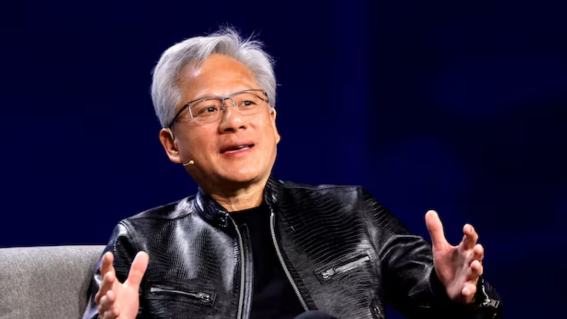
26 February 2026 (Navroze Bureau) : In a clear message to Wall Street and the broader technology sector, Jensen Huang, CEO of Nvidia, has warned investors to brace for a renewed and intensified competitive battle with longtime rivals Intel and AMD.
Speaking during a recent investor briefing, Huang acknowledged that while Nvidia has surged ahead in artificial intelligence (AI) chips and data center dominance, competitors are aggressively repositioning to reclaim lost ground. The next phase of the semiconductor race, he suggested, will be more intense, more strategic, and potentially transformative for the global computing landscape.
AI Leadership Under Pressure
Over the past two years, Nvidia has emerged as the undisputed leader in AI accelerators, with its GPUs powering generative AI models, cloud infrastructure, and enterprise data centers worldwide. The explosive demand for AI workloads has driven record-breaking revenues and positioned Nvidia as one of the world’s most valuable technology companies.
However, Huang emphasized that leadership in semiconductors is never permanent. Intel is investing heavily in advanced manufacturing and AI chips, while AMD continues to gain momentum with competitive data center processors and accelerators. Both companies are targeting the same hyperscale customers that fueled Nvidia’s growth.
Industry analysts note that Intel’s restructuring and renewed focus on foundry services could alter supply chain dynamics, while AMD’s aggressive product roadmap aims to challenge Nvidia directly in high-performance computing and AI inference workloads.
A Three-Way Battle in Data Centers
The battleground is shifting rapidly toward AI-driven data centers. Nvidia’s GPU ecosystem, supported by its CUDA software platform, has created high switching costs for enterprise customers. Yet Intel and AMD are developing alternative architectures and software ecosystems designed to reduce reliance on Nvidia hardware.
Huang reassured investors that Nvidia’s advantage lies not just in silicon performance but in its integrated hardware-software stack. “We’re not just building chips; we’re building computing platforms,” he said, pointing to Nvidia’s expanding portfolio in networking, AI software frameworks, and cloud services.
Still, the competitive landscape is tightening. AMD’s latest accelerators are gaining traction among cloud providers, and Intel’s AI-focused Xeon processors aim to capture inference workloads at scale. The result is an increasingly fragmented market where pricing pressure and rapid innovation cycles are becoming the norm.
Manufacturing and Supply Chain Stakes
Beyond product competition, manufacturing capabilities are central to the renewed rivalry. Intel’s ambition to become a leading global foundry could shift power dynamics in chip production, particularly as geopolitical tensions continue to affect semiconductor supply chains.
Nvidia, which relies on third-party manufacturers, must navigate capacity constraints and export regulations, especially concerning AI chips destined for certain international markets. Meanwhile, AMD also depends on external foundries but has focused on efficient design and performance-per-watt improvements to stay competitive.
Huang acknowledged these structural challenges, noting that supply resilience and diversified partnerships will be critical as AI adoption accelerates across industries.
Investor Expectations and Market Volatility
For investors, Huang’s remarks signal both confidence and caution. Nvidia’s growth trajectory has been extraordinary, but sustaining that momentum requires defending market share against highly motivated competitors.
Market analysts suggest that increased competition could moderate margins over time. However, they also believe the total addressable market for AI infrastructure is expanding so rapidly that multiple players can thrive simultaneously.
Huang framed the situation as an innovation race rather than a zero-sum game. “The world’s demand for AI computing is still in its early stages,” he noted. “This is not a small market we’re fighting over—it’s a market being created in real time.”
Expanding Beyond GPUs
To fortify its position, Nvidia is broadening its portfolio into automotive AI, robotics, edge computing, and AI-powered enterprise software. These expansions aim to diversify revenue streams and reduce dependence on a single segment.
Intel and AMD are following similar diversification strategies, investing in AI PCs, embedded systems, and custom silicon solutions for enterprise clients. The convergence of AI, cloud computing, and edge technologies ensures that the competitive arena extends far beyond traditional CPUs and GPUs.
The Road Ahead
As the semiconductor industry enters its next growth cycle, the rivalry among Nvidia, Intel, and AMD is poised to reshape computing infrastructure globally. With AI becoming foundational to sectors ranging from healthcare to finance, chipmakers are no longer just hardware suppliers—they are architects of the digital economy.
Huang’s message to investors was clear: competition will intensify, but Nvidia intends to stay ahead through relentless innovation, ecosystem expansion, and strategic partnerships.
The renewed chip war is not merely about performance benchmarks. It is about defining the future of artificial intelligence and high-performance computing. And in this high-stakes contest, every product launch, manufacturing breakthrough, and software update could tip the balance.
For now, Nvidia remains firmly in the lead. But as Intel rebuilds and AMD accelerates, the next chapter of the semiconductor battle promises to be one of the most closely watched corporate rivalries in modern tech history.
Summary:
Nvidia CEO Jensen Huang warned investors of intensifying competition with Intel and AMD as the AI chip race accelerates, signaling a new phase of rivalry in global semiconductor and data center markets.