

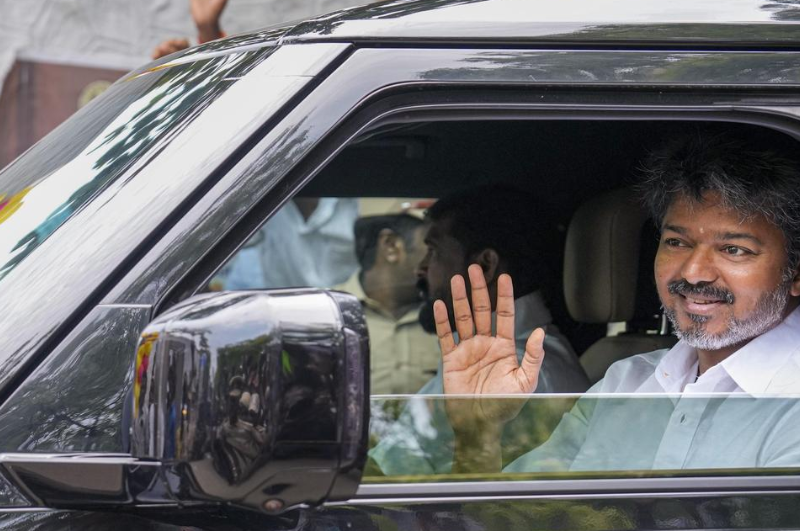
May 5 2026 (Navroze Bureau) : Sri Lankan media outlets have turned their attention to the political developments in southern India, particularly the recent electoral success of Vijay in Tamil Nadu. The coverage reflects not only the scale of the victory but also the broader cultural and political connections between Tamil communities across borders.
Vijay, a prominent film star who recently stepped into active politics, has made headlines after securing a significant win that many analysts describe as a turning point in the state’s political landscape. His transition from cinema to politics has been closely followed, and his electoral success has now captured international attention, particularly in neighboring Sri Lanka.
Media organizations in Sri Lanka have highlighted the magnitude of Vijay’s victory, often framing it as a reflection of his mass appeal and strong grassroots support. Reports emphasize how his popularity as an actor has translated into political capital, enabling him to connect with voters across different demographics.
The coverage also underscores the cultural ties between Tamil Nadu and Sri Lanka’s Tamil population. Many Sri Lankan Tamils have long followed developments in Tamil Nadu politics, given shared linguistic, cultural, and historical connections. Vijay’s rise, therefore, resonates beyond India’s borders, attracting attention from audiences who see parallels in their own socio-political contexts.
Analysts quoted in Sri Lankan media suggest that Vijay’s victory could influence political discourse among Tamil communities in Sri Lanka as well. While the political systems of the two regions are distinct, the symbolic impact of a popular figure successfully entering politics is seen as noteworthy.
Reports have also examined Vijay’s campaign strategy, highlighting his focus on youth engagement, social welfare, and governance reforms. His ability to mobilize first-time voters and leverage his fan base has been cited as a key factor in his success. Sri Lankan commentators have drawn comparisons with other celebrity-turned-politicians, noting both the opportunities and challenges such figures face.
At the same time, the coverage has not been without caution. Some analysts have pointed out that sustaining political success requires more than popularity. Governance, policy-making, and institutional experience will play crucial roles in determining Vijay’s long-term impact.
The attention from Sri Lanka also reflects the interconnected nature of regional media in South Asia. Developments in one part of the region often find resonance elsewhere, especially when they involve figures with widespread recognition. Vijay’s stature as a film star has contributed significantly to this cross-border interest.
Social media has further amplified the story, with discussions spanning both Indian and Sri Lankan audiences. Hashtags related to Vijay’s victory have trended in multiple regions, highlighting the reach of his influence. Fans and political observers alike have shared their views, creating a dynamic online conversation.
The political implications of Vijay’s win are also being closely watched within India. His entry adds a new dimension to Tamil Nadu’s political landscape, traditionally dominated by established parties. Observers are keen to see how his presence will shape alliances, voter behavior, and policy debates in the coming years.
For Sri Lankan media, the story offers an opportunity to explore broader themes of leadership, representation, and the evolving role of public figures in politics. By focusing on Vijay’s journey, these outlets are engaging their audiences in discussions that extend beyond national boundaries.
The coverage also highlights the role of media in shaping public perception. By framing Vijay’s victory as a significant regional event, Sri Lankan outlets are contributing to a narrative that emphasizes shared cultural identity and mutual interest.
Experts believe that such cross-border attention can foster greater understanding and dialogue between communities. At the same time, they caution against overgeneralization, noting that each political context has its own unique dynamics.
As Vijay begins his political journey, both Indian and Sri Lankan audiences will be watching closely. His ability to navigate the complexities of governance while maintaining public support will be critical in determining his future trajectory.
In conclusion, the spotlight on Vijay’s victory in Tamil Nadu by Sri Lankan media underscores the regional significance of his rise. It reflects the deep cultural ties between the two regions and highlights the broader impact of political developments in an increasingly interconnected world.
Summary:
Sri Lankan media highlighted Vijay’s big political win in Tamil Nadu, reflecting cross-border cultural ties and growing regional interest in the actor-turned-politician’s rising influence and future political trajectory.