

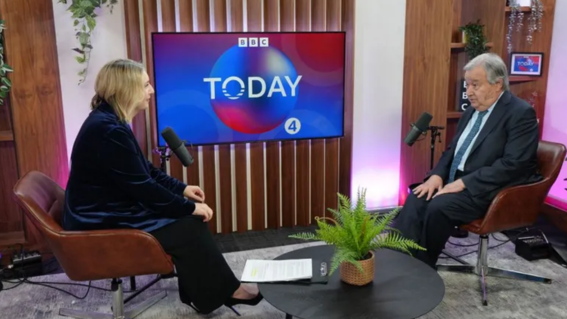
19January 2026: United Nations Secretary-General António Guterres has delivered a candid assessment of global power dynamics, stating that the United States often behaves as though its power matters more than international law. His remarks, made during an interview with the BBC, have sparked fresh debate about the role of major powers, the credibility of global institutions, and the future of the rules-based international order.
Guterres’ comments come at a time when international law is increasingly tested by ongoing conflicts, geopolitical rivalries, and unilateral actions by powerful nations. The UN chief’s statement reflects growing frustration within the international community over the weakening authority of multilateral institutions and the selective application of global norms.
According to Guterres, international law was designed to ensure that all nations, regardless of size or power, are treated equally under a common framework. However, he suggested that in practice, powerful countries often act outside these frameworks when it suits their strategic interests. While he did not limit his criticism to any one nation, his remarks clearly pointed toward Washington’s influence in shaping global decisions.
The Secretary-General emphasized that the credibility of the United Nations and the global legal system depends on consistent respect for international law. When major powers ignore or reinterpret rules to suit their interests, it undermines trust in multilateral institutions and weakens the overall system designed to maintain peace and stability.
Observers believe Guterres’ statement is a reflection of growing concern about the erosion of multilateralism. In recent years, international institutions have struggled to respond effectively to conflicts, humanitarian crises, and violations of sovereignty. Critics argue that political interests of powerful nations often block collective action, particularly within the UN Security Council, where veto powers frequently prevent resolutions from being passed.
The interview has drawn strong reactions from political analysts and diplomats around the world. Some see Guterres’ words as a bold and necessary acknowledgment of uncomfortable truths about global power structures. Others view the comments as risky, warning that such blunt criticism could further strain relations between the UN and its most influential member states.
Supporters of the UN chief argue that his remarks highlight a critical issue: the gap between the ideals of international law and the realities of geopolitical power. They point out that international law is only effective when all nations, especially the most powerful, commit to upholding it consistently. Without that commitment, the global system risks descending into a landscape where might makes right.
The comments also revive long-standing debates about the structure of the United Nations itself. Many countries, particularly in the developing world, have long argued that the current system disproportionately favors powerful nations. Calls for reform of the UN Security Council, including changes to veto power and representation, have grown louder in recent years, though meaningful reform has remained elusive.
For smaller nations, the issue is particularly significant. International law is often seen as their primary protection against coercion and aggression. When powerful states appear to operate above the law, it creates fear and uncertainty among less influential countries, undermining their confidence in global institutions.
Guterres also stressed the importance of rebuilding trust in multilateral cooperation. He warned that without strong respect for international law, the world risks becoming more fragmented, with countries increasingly acting in isolation rather than through collective frameworks. Such a shift, he suggested, could make it more difficult to address global challenges such as climate change, pandemics, economic instability, and armed conflict.
The remarks come at a time when global tensions are high, with ongoing conflicts in multiple regions and growing polarization between major powers. In this environment, the role of international institutions is more important than ever, yet their authority appears increasingly fragile.
Public reaction to Guterres’ statement has been mixed. Some have praised his honesty and courage in speaking openly about the imbalance of power in global politics. Others have questioned whether such public criticism will lead to meaningful change or simply deepen existing divisions between global institutions and powerful governments.
Diplomatic experts believe the UN chief’s comments may serve as a wake-up call rather than a direct challenge. By highlighting the issue, Guterres may be attempting to push global leaders toward renewed commitment to international norms and legal frameworks.
Ultimately, the statement underscores a broader concern about the future of the international system. As power politics increasingly dominate global affairs, the principles of equality, justice, and rule of law face growing pressure. Whether the world’s most powerful nations will choose to reaffirm their commitment to these principles remains uncertain.
What is clear, however, is that Guterres’ words have reignited an important global conversation. The tension between power and principle has always existed in international relations, but in an era of global crises, the consequences of ignoring international law may be more severe than ever before.
Summary
UN Secretary-General António Guterres said the US often prioritises power over international law, warning that such behaviour undermines multilateral institutions and weakens global trust in the rules-based international system.