

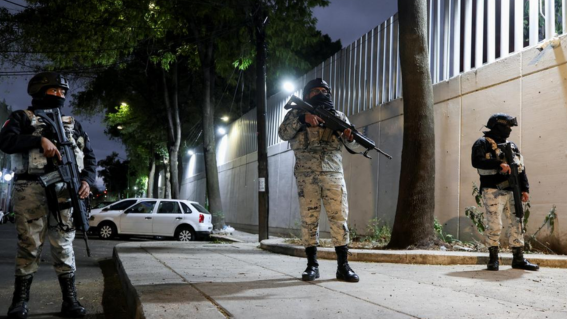
23 February 2026 (Navroze Bureau) : The White House has confirmed that the United States provided intelligence support to the Mexican government during a high-profile security operation that resulted in the death of notorious cartel leader Nemesio Rubén Oseguera Cervantes, widely known as El Mencho. The confirmation marks one of the clearest acknowledgements yet of behind-the-scenes cooperation between the two countries in tackling organised crime and drug trafficking.
El Mencho was the founder and long-time leader of the Jalisco New Generation Cartel (CJNG), considered one of Mexico’s most powerful and violent criminal organisations. The cartel has been linked to large-scale drug trafficking operations, including the production and distribution of fentanyl and other synthetic opioids that have fuelled a public health crisis in the United States.
US Confirms Intelligence Role
In a statement delivered during a White House briefing, officials confirmed that US agencies shared intelligence with Mexican authorities to assist in locating and targeting El Mencho. However, the administration stressed that the operation itself was planned and executed by Mexican security forces, underlining that there was no direct US military involvement on the ground.
White House officials described El Mencho as a “priority target” due to his cartel’s role in cross-border drug trafficking, arms smuggling, and violent attacks against both civilians and security forces in Mexico. The intelligence sharing, they said, was part of ongoing bilateral cooperation frameworks aimed at dismantling transnational criminal networks.
The Operation and Its Aftermath
The operation reportedly took place in western Mexico, a region long considered a stronghold of the CJNG. Mexican security forces launched a coordinated raid based on actionable intelligence, leading to a fierce confrontation in which El Mencho was killed. Several other cartel members were also reported to have been killed or arrested during the operation.
Following the raid, authorities across multiple Mexican states were placed on high alert amid fears of retaliatory violence. The CJNG has a history of responding aggressively to major setbacks, often targeting infrastructure, security forces, and civilian areas. Reports of road blockades, arson attacks, and armed clashes surfaced in the hours following the operation, highlighting the volatility surrounding the cartel’s leadership vacuum.
Significance of El Mencho’s Death
El Mencho had evaded capture for years despite being one of the most wanted drug lords in the world. His ability to expand the CJNG into a dominant force was built on extreme violence, territorial control, and a sophisticated organisational structure. Security analysts believe his death represents a major symbolic and operational blow to the cartel.
However, experts caution that the killing of a cartel leader does not automatically translate into reduced violence. In many cases, leadership changes trigger internal power struggles, splinter groups, and renewed violence as factions compete for control.
US–Mexico Security Cooperation
The White House’s confirmation of intelligence support reflects the deepening security cooperation between the United States and Mexico, particularly in the fight against drug trafficking and organised crime. US officials reiterated that intelligence sharing is conducted at the request of Mexican authorities and within established legal frameworks.
The administration also emphasised that such cooperation is focused on protecting public safety on both sides of the border. The fentanyl crisis in the US has intensified pressure on law enforcement agencies to disrupt supply chains at their source, making collaboration with Mexican forces a strategic priority.
Political and Diplomatic Implications
The acknowledgement of US involvement is likely to spark debate in both countries. In Mexico, foreign participation in security operations has historically been a sensitive issue, closely tied to questions of sovereignty. Mexican officials have repeatedly insisted that national forces remain in command of all domestic operations, even when supported by foreign intelligence.
In the US, the confirmation may fuel political discussions about the extent of American involvement in foreign security matters and the effectiveness of intelligence-led operations against global drug networks.
What Comes Next
With El Mencho dead, attention now turns to the future of the CJNG. Analysts believe the cartel’s decentralised structure could allow it to continue operating despite the loss of its leader, at least in the short term. Mexican authorities are expected to intensify operations against remaining leadership figures to prevent the group from regrouping.
The White House said it would continue working closely with Mexico to combat drug trafficking, stressing that intelligence cooperation remains a key tool in addressing transnational crime.
While the killing of El Mencho marks a significant moment in the fight against organised crime, officials on both sides of the border acknowledge that dismantling powerful cartels remains a long-term challenge requiring sustained cooperation, institutional reform, and coordinated enforcement efforts.
Summary
The White House confirmed the US shared intelligence with Mexico in an operation that killed CJNG leader El Mencho, highlighting deep security cooperation amid concerns over cartel retaliation and future violence.