

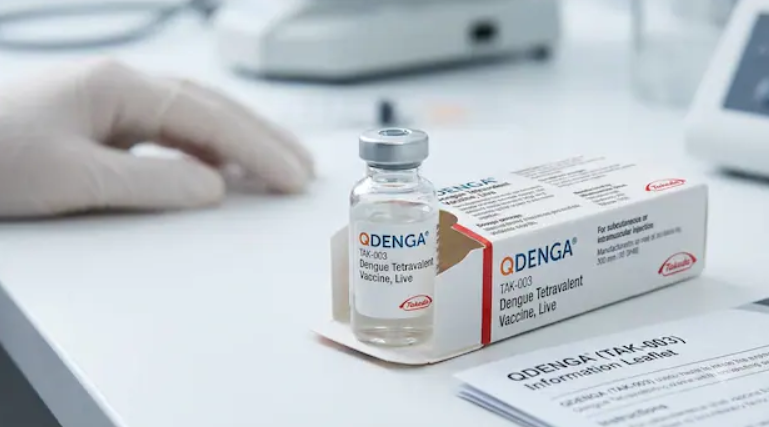
17 Aug 2026 (Navroze Bureau) : As Qdenga, Takeda’s dengue vaccine, becomes more widely available, questions are emerging about whether vaccination could affect dengue blood-test results. The answer depends on which diagnostic test is used and how soon after vaccination it is performed.
Why Qdenga Can Affect Some Tests
Qdenga is a live-attenuated vaccine containing weakened versions of all four dengue virus serotypes. After vaccination, the vaccine virus can briefly circulate in the body, a process known as vaccine viraemia.
During this period, some dengue diagnostic tests can return positive results even when a person does not have a wild-type dengue infection. Official product information specifically warns that dengue diagnostic tests may be positive during vaccine viraemia and cannot by themselves distinguish vaccine virus from naturally acquired dengue.
Which Dengue Tests Can Be Affected?
Tests that detect dengue antibodies, particularly IgM and IgG, can be affected because vaccination deliberately stimulates the immune system to produce dengue-specific antibodies.
More unusually, NS1 antigen testing can also be positive shortly after Qdenga vaccination, because the vaccine contains the NS1 antigen targeted by many dengue antigen tests.
What About PCR Tests?
PCR and other nucleic-acid tests detect dengue viral genetic material. After Qdenga vaccination, specialized testing may be required to determine whether detected virus is vaccine-derived or wild-type dengue.
PAHO recommends specific approaches for people who develop dengue-like symptoms within 30 days of receiving a Qdenga dose, precisely because vaccine virus can complicate laboratory interpretation.
Does a Positive Dengue Test Mean You Have Dengue?
Not necessarily, particularly soon after vaccination.
Doctors and laboratories need to know that the patient has recently received Qdenga before interpreting a positive dengue result. The vaccination history can be crucial when deciding whether a result represents a natural infection or a vaccine-related response.
Why the Timing Matters
The potential diagnostic confusion is mainly relevant soon after vaccination, when vaccine viraemia can occur. Product information says vaccine viraemia generally begins around the second week after the first dose and is usually short-lived; it is rarely detected after the second dose.
The Bottom Line
Qdenga can show up on some dengue diagnostic panels, particularly certain antibody and NS1 antigen tests during the period when vaccine virus or vaccine-induced immune responses are detectable.
That does not mean the vaccine has caused dengue disease. Anyone undergoing dengue testing after vaccination should tell the healthcare provider when the vaccine was received and which dose was given, so the results can be interpreted correctly.