

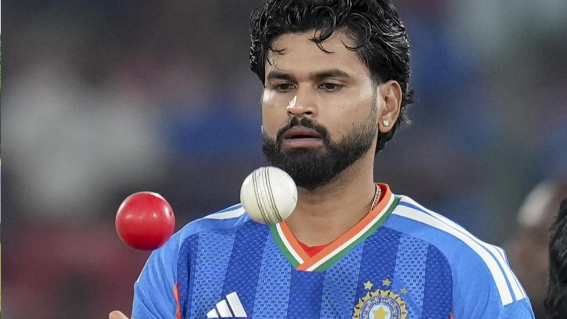
19 October 2026 (Navroze Bureau) Indian cricket’s demanding international schedule has once again raised questions about player workload, travel fatigue and the balance between playing opportunities and physical recovery. The issue has come into focus following the packed calendar of India’s Twenty20 international team under captain Shreyas Iyer, who has experienced an intense run of matches across multiple countries in a relatively short period.
A report published by CricRed on October 19, 2026, highlighted the challenge facing Iyer and the Indian team, pointing to a sequence of international fixtures that has required frequent travel across continents. The central question is whether an increasingly crowded cricket calendar gives players enough time to recover physically and mentally while maintaining consistent performance.
Shreyas Iyer’s Rapid Return to the T20 Setup
Iyer’s return to India’s T20 international setup followed a lengthy period away from the squad. After spending around two and a half years outside the team, he was brought back following India’s successful T20 World Cup title defence in March 2026.
The experienced batter was entrusted with the captaincy, replacing Suryakumar Yadav. The appointment represented a significant opportunity for Iyer, who had previously demonstrated his leadership abilities in franchise cricket, including leading Kolkata Knight Riders to an Indian Premier League title and Punjab Kings to the final in the following season.
However, the demands of international cricket have quickly presented a different challenge. According to the CricRed report, Iyer’s first 114 days as captain involved 21 matches against eight opponents: Ireland, England, Zimbabwe, Afghanistan, Japan, Sri Lanka, Pakistan and the West Indies. During this period, India played across several countries and time zones, increasing the logistical and physical demands on the squad.
The team’s schedule also included a five-match T20I series against New Zealand, beginning in Christchurch on October 22. The quick succession of international assignments has highlighted how little downtime players may have between tours.
Why a Crowded Cricket Calendar Is a Concern
Modern international cricket involves more than the hours spent on the field. Players must also manage flights, hotel changes, practice sessions, media commitments and adjustments to different time zones. When matches take place in different countries within a short window, the time available for sleep, recovery and preparation can become limited.
T20 cricket is shorter than the traditional Test format, but it still places considerable physical and mental demands on players. Batters face high-intensity situations, bowlers must repeatedly deliver at speed, and fielders are expected to maintain sharp reactions throughout a match.
For a captain such as Iyer, the workload extends beyond batting and fielding. He must also prepare strategies, study opposition players, make decisions during matches and manage the confidence of teammates. Maintaining concentration across a continuous series of tours can be difficult without adequate recovery time.
The scheduling debate is therefore not simply about the number of matches. It is also about how those matches are distributed, how much travel is involved and whether players receive enough time to prepare properly for each assignment.
Balancing International Cricket and Franchise Commitments
India’s leading cricketers often move between international fixtures, domestic competitions and franchise tournaments. While these competitions provide valuable playing opportunities, they can also create competing demands on players’ time.
International cricket requires players to adapt to different opponents, conditions and team combinations. Franchise competitions can involve separate travel schedules and additional preparation requirements. Without effective workload management, a player may find it difficult to maintain peak performance throughout the year.
Teams can address some of these pressures through planned rest periods, squad rotation and careful management of training intensity. Rotating players, particularly during long series, can help reduce fatigue while allowing reserve players to gain international experience.
However, rotation also involves trade-offs. Frequent changes can disrupt team combinations, and resting a captain or key player may affect preparation and continuity. Team management must therefore consider the importance of each fixture alongside players’ individual workloads.
The Challenge for Team Management
India’s selectors and coaching staff face the task of maintaining competitiveness without placing unnecessary demands on the same group of players throughout the calendar.
A well-planned schedule should allow sufficient recovery between demanding tours while preserving opportunities for emerging players. Monitoring workload, fitness and signs of fatigue can also help teams identify when an individual needs additional rest.
The International Cricket Council, national boards and tournament organisers all influence the wider calendar. Coordinating bilateral series with major international tournaments and domestic competitions remains a challenge, particularly as the sport expands across formats and markets.
A more balanced approach would require coordination between organisers rather than relying exclusively on individual teams to manage the consequences of a crowded schedule.
How Much Cricket Is Too Much?
There is no single number of matches that determines when a player’s workload becomes excessive. The impact depends on the format, travel distances, playing conditions, recovery periods and the individual athlete’s fitness.
For India, the scheduling concerns surrounding Iyer provide a useful example of the challenge. A packed calendar creates opportunities for players to represent their country and develop as leaders, but those opportunities must be balanced against the need for sustained physical and mental performance.
The objective is not necessarily to reduce international cricket across the board. Instead, it is to ensure that fixtures are arranged in a way that allows players to compete at a high level without compromising recovery.
As India continues through its international programme, the balance between scheduling demands and player welfare is likely to remain an important discussion in cricket. Ultimately, a successful calendar must serve both the game’s competitive ambitions and the long-term well-being of the players who make it possible.