

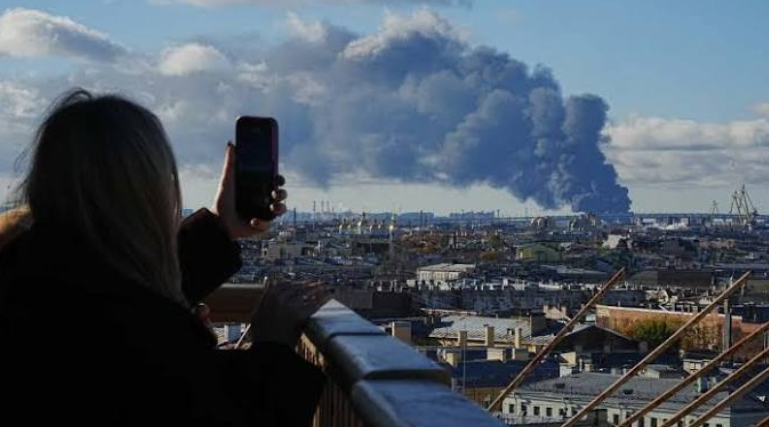
19 October 2026 (Navroze Bureau) A massive Ukrainian drone attack on Russia on October 18, 2026, set an oil export terminal and an oil depot ablaze in St. Petersburg, marking one of the largest aerial assaults of the war. Russian authorities said their air defence forces intercepted or destroyed more than 1,000 Ukrainian drones across several regions, while the attack caused casualties and damage to energy and commercial infrastructure.
The strikes came as the war between Russia and Ukraine continued to escalate and diplomatic efforts faced fresh challenges. The attacks also heightened tensions between Kyiv and Washington, with US President Donald Trump criticising Ukrainian strikes on Russian oil infrastructure and the future of additional sanctions against Moscow remaining uncertain.
Oil Terminal and Depot Catch Fire
St. Petersburg Governor Alexander Beglov confirmed that fires had broken out at the St. Petersburg Oil Terminal, the Ruchi oil depot and industrial warehouses in the Kolpino district. Emergency crews were deployed to contain the fires and assess the damage.
According to local authorities, at least one person was killed and five others were injured in the attack on St. Petersburg. Residential buildings and homes were also reportedly damaged.
The strikes extended beyond energy infrastructure. Russian online retailer Ozon confirmed a fire at its logistics centre, while technology company VK said its data centre in the Leningrad region had been targeted. VK reported that its services remained available to users despite the incident.
The attacks raised concerns about the security of facilities that play an important role in Russia’s oil exports, logistics networks and digital services.
Russia Says More Than 1,000 Ukrainian Drones Were Destroyed
Russia’s Defence Ministry said its air defence forces had destroyed 1,015 Ukrainian drones overnight across 15 Russian regions, the annexed Crimean Peninsula and the Black Sea.
Alexander Drozdenko, governor of the surrounding Leningrad region, said 145 drones had been shot down in the region. He also reported that approximately 20,000 people were left without electricity following damage associated with the attacks.
The scale of the reported interceptions indicates the geographical reach of the overnight assault. However, the Russian Defence Ministry’s figure refers to drones it said were destroyed or intercepted, rather than independently confirming the total number launched by Ukraine.
The attack was described by Russian media as among the largest the St. Petersburg region had experienced since the beginning of the full-scale war
Ukraine’s Campaign Against Russian Energy Infrastructure
Ukraine has increasingly targeted Russian oil refineries, export terminals and other energy-related facilities during the war. Such attacks are intended to disrupt infrastructure that supports Russia’s economy and its ability to sustain military operations.
Kyiv resumed strikes on Russian oil facilities after a brief pause earlier in October. Ukrainian officials said Moscow had continued attacking Ukraine’s own energy infrastructure despite US President Donald Trump’s announcement of an energy ceasefire.
Ukrainian President Volodymyr Zelenskyy said Russia had carried out 76 attacks against Ukraine’s energy, oil and gas sectors in the week following the ceasefire announcement. He argued that Russia had not taken reciprocal steps to reduce attacks on Ukrainian infrastructure. These figures were provided by the Ukrainian president and were not independently verified in the cited reporting.
The continued strikes on both sides have complicated efforts to reduce attacks on energy facilities and protect civilians from the consequences of the war.
Trump’s Position Adds to Tensions With Kyiv
The St. Petersburg attack came amid growing disagreement between Washington and Kyiv over military strategy and negotiations with Moscow.
Trump criticised Ukraine’s attacks on Russian oil infrastructure and said he had decided to delay additional sanctions against Russia because he did not want to undermine negotiations. His position drew criticism from Ukrainian officials, who argued that easing pressure on Moscow could encourage Russia to continue its military campaign.
Zelenskyy said that sanctions relief and diplomatic discussions had not persuaded Russia to stop attacks on Ukrainian energy sites. He also welcomed the resumption of US intelligence-sharing after a period in which it had been suspended.
The dispute highlights the difficulties facing efforts to negotiate an end to the war while both sides continue military operations against strategically important infrastructure.
Russian Strikes Also Cause Casualties in Ukraine
While Ukrainian drones targeted Russian energy and commercial facilities, Russian forces continued striking targets in Ukraine.
Zelenskyy said Russian attacks overnight had killed two people and injured 12 others, including two children. Ukrainian officials also reported damage to energy infrastructure and other facilities in several regions.
The continuing attacks have left communities on both sides dealing with casualties, damaged property and disruptions to essential services. Energy infrastructure remains a major focus of the conflict, raising concerns about the impact on electricity supplies and the wider economy as the war continues.
A Further Escalation in the Russia-Ukraine War
The drone assault on St. Petersburg underscores the expanding reach of Ukraine’s campaign against Russian infrastructure. Fires at the oil terminal and depot, damage to commercial facilities and reported power outages in the surrounding region demonstrate the potential consequences of large-scale aerial attacks.
Russian authorities said their air defences had intercepted more than 1,000 drones, while emergency services continued responding to fires and damage. Ukraine, meanwhile, has maintained that its strikes are a response to Russia’s continued attacks on Ukrainian energy infrastructure.
With diplomatic disagreements continuing alongside military operations, the prospects for a sustained reduction in attacks remain uncertain. The latest strikes have added pressure on both governments as they face questions over civilian safety, infrastructure security and the future of efforts to negotiate a ceasefire.