

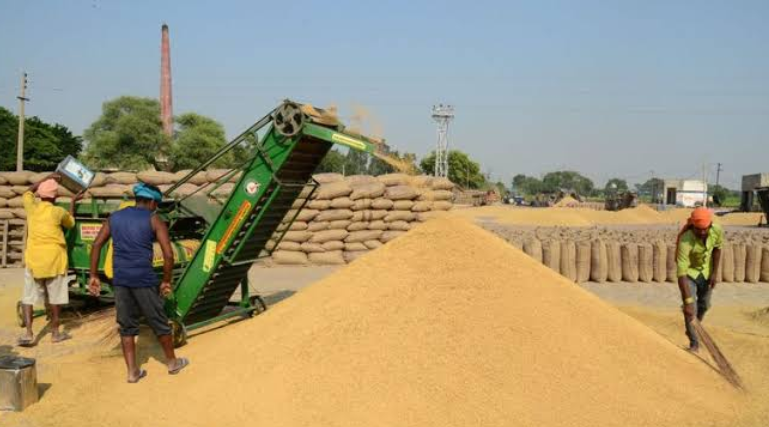
19 October 2026 (Navroze Bureau) Farmers in Punjab’s Fazilka district are facing mounting financial difficulties after heavy rainfall damaged large quantities of paddy stored at the local grain market. Several days after the downpour on October 11, affected farmers are still struggling to sell their damaged produce, as government procurement agencies and private traders remain reluctant to purchase the discoloured and rain-soaked grain.
The damaged crop has left farmers worried about recovering their investment after months of hard work. While procurement agencies have reportedly declined to purchase some of the affected stocks, private traders are offering prices below the Minimum Support Price (MSP), adding to the financial pressure on growers.
Rainwater Damages Paddy Stocks
The Fazilka grain market witnessed severe waterlogging following heavy rainfall on October 11. Poor drainage arrangements allegedly allowed rainwater to accumulate across parts of the market, damaging paddy stored in heaps and bags.
According to reports, water reached depths of up to three feet in some areas. Several stocks were washed away, while many filled bags remained submerged. The incident affected farmers, commission agents and others involved in the procurement process.
The immediate concern is now the condition of the damaged paddy. Grain exposed to rainwater has become discoloured, and some stocks have reportedly heated up, affecting their quality and marketability. Farmers are attempting to recover whatever produce remains saleable, but the damage has made procurement more difficult.
The incident has also renewed concerns about drainage facilities at the grain market, where large quantities of harvested paddy are brought during the procurement season.
Government Agencies and Private Traders Reluctant to Buy
Farmers say the biggest challenge is finding buyers willing to accept the damaged crop. According to The Tribune, procurement agencies have been reluctant to purchase the affected paddy, while private traders are offering substantially lower prices than the MSP.
Prem Kumar, a farmer from Jorki Kankar Wali village, said his paddy had been damaged and discoloured by the rain, but he could not find a buyer even when he was willing to accept a reduced price.
Before the rainfall, private traders, including rice mill owners, had reportedly been purchasing the PR variety of paddy at ₹2,466 per quintal, which was ₹5 above the MSP of ₹2,461 per quintal. After the crop was damaged, however, traders became reluctant to offer comparable prices.
The situation has left farmers facing a difficult choice: sell their produce at a loss or wait for authorities to address procurement and compensation concerns. Delays could further complicate matters if the grain deteriorates or remains unsold for an extended period.
Farmers Demand Government Intervention
Farmers have called on the government to honour its commitment to procure their produce. Ashok Kumar of Penchan Wali village and Gurpinder Singh of Banwala village said the government had promised to procure every grain and urged officials to ensure that rain-affected paddy was not left without a buyer.
For farmers, the issue extends beyond the immediate loss of grain. Paddy cultivation requires expenditure on seeds, fertilisers, pesticides, labour, irrigation and harvesting. When harvested produce is damaged just before or during procurement, farmers risk losing a significant portion of their expected income.
The demand for government intervention has therefore focused on purchasing grain that remains fit for procurement and providing compensation for stocks that have been washed away or rendered unusable.
The extent to which damaged paddy can be accepted will depend on the condition of the produce and the applicable procurement requirements. Farmers are awaiting clarity on how the affected stocks will be handled.
Nearly 7,000 Quintals Reportedly Damaged
Sanjeev Goldy Sachdeva, president of the Fazilka Arhtiya Association, said nearly 7,000 quintals of paddy had either been washed away or damaged because of the rainfall. He added that a list of the affected stocks had been submitted to the concerned authorities.
The assessment of the losses is still underway. Officials are examining claims to determine how much paddy was washed away, how much was damaged and what compensation may be appropriate.
Mandeep Kamra, secretary of the Fazilka Market Committee, said inspectors from different procurement agencies were verifying the claims. He also noted that some farmers had submitted inflated estimates of their losses, making verification necessary before the assessment could be finalised.
According to Kamra, farmers would be suitably compensated for their losses. However, the final assessment and any subsequent compensation decisions remain important steps for those waiting for relief.
Drainage Problems Under Scrutiny
The damage has brought the grain market’s drainage arrangements under renewed scrutiny. Farmers and commission agents say the accumulation of rainwater exposed longstanding weaknesses in the system.
Earlier reports from Fazilka described how waterlogging affected large areas of the market, with some locations submerged under several feet of water. Farmers and commission agents had demanded accountability and compensation after their produce was damaged.
The latest situation shows that the consequences of the rainfall have continued beyond the initial flooding. Even after the water receded, discoloured and damaged paddy remained difficult to sell, leaving farmers dependent on procurement decisions and the outcome of the loss assessment.
For affected growers, the immediate priorities are clear: secure buyers for grain that remains suitable for procurement, establish the extent of the losses and ensure that eligible compensation reaches those affected.
Until these issues are resolved, farmers in Fazilka will continue to face uncertainty over the value of their harvested crop and their ability to recover the costs of the current season.