

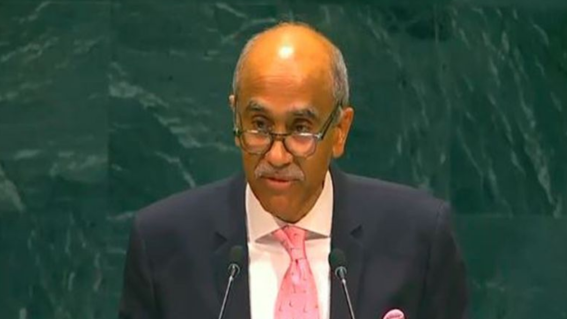
27 October 2026 (Navroze Bureau) India has called for comprehensive reforms of the United Nations Security Council (UNSC), stressing that the veto power held by its five permanent members must be exercised responsibly and should not become an instrument of narrow political expediency. India also urged member states to begin formal, text-based negotiations on reforms with clear timelines and milestones.
India’s Permanent Representative to the United Nations, Ambassador Parvathaneni Harish, delivered the country’s position during discussions at the UN General Assembly on the use of the veto. He argued that the existing arrangements had failed to adequately address concerns about accountability, representation and the effectiveness of the Security Council.
India maintains that the council’s structure must reflect contemporary geopolitical realities rather than remain based on the power arrangements established after the Second World War. New Delhi has repeatedly called for expansion in both permanent and non-permanent membership categories to make the body more representative.
India questions the use of veto power
Harish said the veto was not merely a privilege enjoyed by the five permanent members but also carried a significant responsibility, particularly when decisions concerned international peace and security.
He emphasised that permanent members should exercise restraint when using the power, arguing that decisions affecting global security should not be driven by narrow political considerations.
According to the Indian envoy, the historical use of the veto has raised questions about the Security Council’s credibility. He cited a record of 331 vetoes against approximately 200 resolutions over the organisation’s history, arguing that the concentration of veto power among a small number of countries has affected the council’s ability to act collectively.
The veto allows any of the five permanent members — China, France, Russia, the United Kingdom and the United States — to block a substantive draft resolution, even when it has support from other council members.
India’s position is that the authority should be exercised with greater responsibility and that the wider membership of the United Nations must have a meaningful role in discussions about its use.
Existing accountability mechanism questioned
The Indian representative also referred to a mechanism introduced in 2022 under UN General Assembly Resolution 76/262. The measure requires the General Assembly to convene a formal debate within 10 working days after a veto is cast in the Security Council, giving member states an opportunity to discuss the decision.
Harish said the mechanism was intended to improve transparency and accountability but argued that the continued use of vetoes showed that it had not sufficiently changed the behaviour of permanent members.
India’s position highlights a broader challenge within the UN system: although the General Assembly can debate a veto, it cannot simply overturn it through that procedure. The permanent members retain their powers under the UN Charter.
The debate has therefore renewed questions about how the international community can improve accountability while working within the existing institutional framework.
India calls for comprehensive reforms
Harish argued that the veto issue cannot be considered separately from other aspects of Security Council reform. He said negotiations must address all five major areas of discussion simultaneously: categories of membership, the question of veto, regional representation, the size of an expanded council and its working methods.
India has warned that restricting discussions to veto reform alone would leave the underlying imbalance in the council’s composition unresolved.
The country is seeking the early commencement of text-based negotiations, supported by clearly defined timelines and milestones. Such negotiations would move discussions beyond the exchange of general positions towards concrete proposals that member states could consider and negotiate.
India has also called for expansion in both permanent and non-permanent membership categories. It argues that reform limited to adding non-permanent seats would not adequately address the lack of permanent representation for several regions.
The demand reflects New Delhi’s longstanding position that the council should better represent the present-day international community, including countries and regions whose influence and populations have grown considerably since the United Nations was established in 1945.
‘Effective veto’ beyond formal decisions
The Indian envoy also drew attention to what he described as an “effective” or “de facto” veto within the Security Council. He said the practice of requiring consensus on certain council outputs can allow a single member to block presidential statements, press statements and decisions of sanctions committees.
Unlike a formal veto on a draft resolution, these informal blocking mechanisms may prevent an initiative from progressing without a public vote or a detailed explanation.
Harish argued that these practices deserve attention as part of a wider review of the council’s working methods. India believes that improving transparency and accountability requires examining not only formal voting procedures but also the ways in which decisions are negotiated and blocked behind the scenes.
The remarks underline India’s view that institutional reform should address the council’s overall decision-making structure rather than focus exclusively on the formal veto.
India backs equal rights for new permanent members
India also reiterated its support for the Common African Position on Security Council reform. It said that if the veto continues to exist, all permanent members of a reformed council should enjoy equal rights and responsibilities.
Harish opposed the creation of a separate category of permanent members with different privileges, whether or not those members received veto powers. According to India’s position, creating another tier could institutionalise the inequalities that reform is intended to address.
The position aligns with India’s broader demand for an expanded permanent membership that gives underrepresented regions a stronger role in international decision-making.
Africa, Asia-Pacific and Latin America have long sought greater representation on the council. However, UN member states remain divided over the number of additional seats, their distribution among regions, the future of veto powers and the model of expansion.
Any major structural reform would require agreement among member states and changes to the UN Charter, making the process politically complex.
Reform debate continues at the United Nations
The latest intervention comes amid continuing discussions at the United Nations about equitable representation and the council’s ability to respond to modern international challenges.
Established in 1945, the Security Council has primary responsibility under the UN Charter for maintaining international peace and security. Its five permanent members hold veto powers, while 10 non-permanent members are elected for two-year terms.
India has repeatedly argued that this structure does not adequately reflect the current distribution of global population, economic influence and regional representation. It is among the countries seeking permanent membership as part of a comprehensive reform package.
The debate over veto use has gained importance amid disagreements among major powers over conflicts and other international security matters. Supporters of reform argue that a more representative council could strengthen its legitimacy, while negotiations continue over how to balance wider representation with the need for effective decision-making.
India’s latest statement calls for member states to move towards concrete negotiations with defined deadlines rather than allow discussions to continue without a clear path to an outcome.
The central question remains whether UN members can agree on a reform model that improves representation, addresses concerns over veto power and enables the Security Council to respond more effectively to threats to international peace and security.