
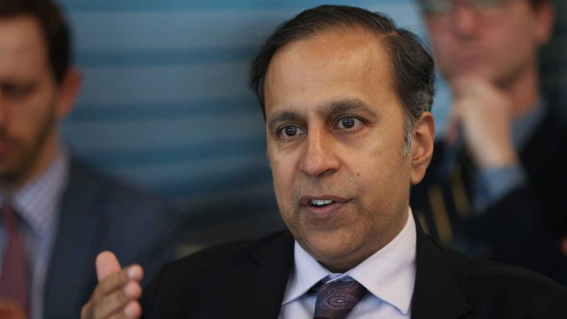
27 October 2026 (Navroze Bureau) US Congressman Raja Krishnamoorthi has introduced a bipartisan resolution backed by 256 cosponsors in the House of Representatives to designate July as Indian American Heritage Month, recognising the contributions of Indian Americans to the United States across science, technology, business, public service, education, arts and culture.
The resolution was introduced on October 26 and has attracted support from more than half of the 435-member House. It aims to recognise generations of Indian Americans who have contributed to the country’s economic growth, scientific progress, cultural diversity and civic life.
Krishnamoorthi, a Democratic representative from Illinois, said Indian Americans had helped shape the United States through scientific breakthroughs, business development, military service and public office. He said the proposed designation would provide an opportunity to honour their legacy and recognise their continuing contributions to American society.
The resolution highlights the achievements of more than 5.2 million people in the United States who identify as Indian American, citing estimates published by the US Census Bureau in 2023.
Why July was chosen
The proposed heritage month has historical significance because of the Luce-Celler Act of 1946. On July 2, 1946, then-President Harry S. Truman signed the legislation into law, making people of Indian and Filipino descent eligible to become naturalised US citizens.
Before the legislation, Indian immigrants faced restrictions that prevented them from obtaining American citizenship. The act marked an important milestone in the history of Indian immigration to the United States and opened a pathway to naturalisation.
By proposing July as Indian American Heritage Month, the resolution seeks to connect contemporary Indian American achievements with this landmark moment in the history of immigration and citizenship.
The measure also recognises the community’s diverse cultural, linguistic and religious backgrounds. Indian Americans come from different regions of India and represent a wide range of traditions, faiths and experiences that contribute to the multicultural character of the United States.
Contributions across science, business and public service
The resolution acknowledges Indian Americans’ achievements in a broad range of fields, including science, medicine, biomedical research, space exploration, artificial intelligence, computing and telecommunications.
It also highlights contributions to entrepreneurship, business, higher education, economic research, journalism, literature and philanthropy. According to the resolution, these achievements have strengthened the country’s economy, supported innovation and enriched its intellectual and cultural life.
Indian Americans have also served at different levels of government and public administration, including in every branch of the US Armed Forces. The measure recognises their participation in public service and their role in shaping institutions across the country.
Beyond professional achievements, the resolution celebrates the community’s influence on American music, cinema, television, literature, cuisine, sports and performing arts. It also recognises efforts by Indian American families and organisations to preserve and share India’s cultural and religious traditions with wider American society.
The proposal presents these contributions as part of the broader story of the United States and its development as a diverse society.
Resolution has 256 cosponsors
The backing of 256 lawmakers gives the proposal support from more than half of the House of Representatives. Krishnamoorthi’s office has described the measure as bipartisan, although a complete list of cosponsors and a party-wise breakdown were not immediately available in the announcement.
The resolution expresses the House’s recognition of Indian Americans as an important part of the country’s diversity and strength. It also calls for support for designating July as Indian American Heritage Month.
However, the proposal is a House resolution, rather than legislation establishing a federal holiday. Its purpose is to express the chamber’s position and recognise the community’s contributions. It would not, by itself, create a federal holiday or require approval from the Senate and the president.
The resolution’s formal number and committee assignment were not available when it was announced.
Recognition of the Indian American community
The proposal comes at a time when Indian Americans continue to hold visible roles in American business, technology, medicine, education, government and cultural life. Their contributions have become an increasingly prominent part of discussions about immigration, entrepreneurship and the diversity of the US workforce.
The proposed heritage month would offer an annual opportunity to highlight the community’s history and achievements, while recognising the experiences of generations of immigrants and their descendants.
For Indian Americans, the designation would also provide a platform to share their heritage with younger generations and the wider public. Schools, cultural organisations and community groups could use such recognition to highlight historical milestones, traditional arts, language, food and the contributions of Indian American leaders.
The resolution’s supporters argue that recognising the community’s history is a way to acknowledge its place in the country’s broader national story.
The next stage will depend on the House’s consideration of the measure. Until it is formally adopted, July remains a proposed designation under this resolution rather than an officially established federal heritage month.