

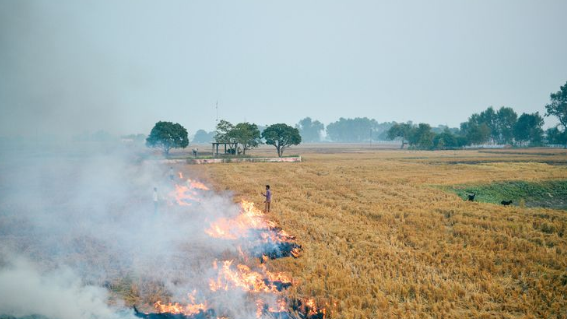
2 November 2026 (Navroze Bureau) The Commission for Air Quality Management (CAQM) has directed authorities in seven districts of Punjab to strengthen surveillance and enforcement measures to prevent paddy stubble burning following a recent rise in farm-fire incidents across the state. The directions were issued during a review meeting held on Sunday, November 1, amid growing concerns over the impact of agricultural fires on air quality during the winter season.
CAQM Member Secretary Tarun Pithode chaired the meeting with Deputy Commissioners, District Magistrates and Senior Superintendents of Police from Faridkot, Firozpur, Barnala, Bathinda, Patiala, Malerkotla and Sangrur.
The meeting reviewed the steps taken by district administrations to control stubble burning and assessed their preparedness for managing paddy residue during the ongoing harvesting season.
Seven Districts Asked to Strengthen Surveillance
During the meeting, the commission asked the seven district administrations to intensify monitoring of agricultural fields and ensure prompt action whenever stubble-burning violations are detected.
Special emphasis was placed on surveillance during evening hours, when farm fires may occur outside the usual monitoring periods. Officials were instructed to maintain close coordination between administrative departments and police teams to identify incidents and respond quickly.
The CAQM also stressed that enforcement should not remain limited to routine inspections. District authorities were asked to ensure that field-level officials actively monitor vulnerable areas and take timely action against violations.
Effective Use of Crop Residue Management Machinery
The availability and deployment of Crop Residue Management (CRM) machinery was another major issue discussed during the review meeting.
The commission directed district administrations to ensure that balers and other agricultural equipment available to farmers are used effectively. These machines help collect and manage paddy straw, reducing the need for farmers to burn crop residue in their fields.
Officials were also asked to strengthen coordination with farmers and other stakeholders to improve the availability and utilisation of machinery during the harvesting period.
The commission emphasised that awareness campaigns should be intensified to inform farmers about alternative methods of managing paddy straw and the environmental consequences of stubble burning.
Police Asked to Play a Greater Role
The CAQM specifically called for greater involvement of police personnel in preventing farm fires and enforcing the restrictions on stubble burning.
The commission said all concerned departments must work together rather than treating the issue as the responsibility of a single agency. District administrations, police officials, agriculture departments and field-level staff were asked to coordinate their efforts.
The directions come at a time when Punjab is witnessing an increase in farm-fire incidents as paddy harvesting progresses. Stubble burning remains a major seasonal concern because smoke from agricultural fires contributes to air pollution across northern India, including the National Capital Region.
Farm Fires Cross 1,500 in Punjab
The latest figures indicate a sharp increase in reported farm fires. According to the CAQM monitoring report dated November 1, Punjab recorded 1,514 stubble-burning incidents during the ongoing paddy harvesting season.
Tarn Taran accounted for the highest number of cases, with 472 incidents, followed by Amritsar with 191 and Firozpur with 186. Together, these three districts contributed more than half of the state’s reported farm fires.
The figures also show that enforcement agencies have stepped up action. Authorities inspected 1,205 locations out of the 1,514 reported incidents and physically verified crop burning at 584 sites. Environmental compensation was imposed in 518 cases, amounting to ₹26.15 lakh, while ₹17.60 lakh had been recovered.
The report also recorded 389 FIRs and 422 red entries in land records in connection with stubble-burning cases.
CAQM’s Wider Monitoring Efforts
The latest directions are part of the commission’s broader efforts to strengthen field-level monitoring during the paddy harvesting season.
Earlier, CAQM deployed flying squads across 18 districts in Punjab and 16 districts in Haryana for the period from October 1 to November 30, 2026. These teams are responsible for assessing ground conditions, coordinating with local authorities and reporting developments to the commission.
The commission has also reviewed preparations in districts such as Amritsar and Tarn Taran, which have been identified as major stubble-burning hotspots.
In addition to field inspections, authorities have been encouraged to improve the use of crop residue management machinery and strengthen arrangements for transporting paddy straw to industries that can utilise it.
Stubble Burning Remains a Major Air Pollution Concern
Paddy stubble burning generally increases after harvesting as farmers prepare their fields for the next crop, particularly wheat. The limited time available between harvesting and the next sowing season can put pressure on farmers to clear agricultural residue quickly.
Burning crop residue releases smoke and particulate matter into the atmosphere, contributing to poor air quality. Weather conditions during the winter months can further aggravate pollution levels across northern India.
The CAQM’s latest directions underline the need for stronger surveillance, effective machinery deployment, farmer awareness and coordinated enforcement.
With farm-fire incidents rising, the coming weeks will be important for Punjab’s efforts to control stubble burning. District administrations have been asked to ensure that available resources are used effectively and that monitoring continues, particularly in areas reporting repeated violations.