
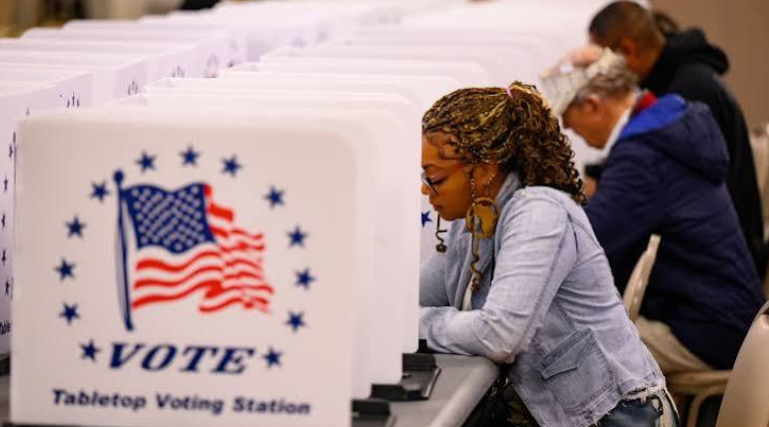
5 November 2026 (Navroze Bureau) US technology and artificial intelligence (AI) stocks came under pressure following the 2026 midterm election results, as Democratic candidates who campaigned against the rapid expansion of data centers secured major victories across the country. The election outcome has raised concerns among investors about stricter regulations, possible construction restrictions and a slowdown in America’s rapidly growing AI infrastructure industry.
The Democratic Party secured control of both the US Senate and House of Representatives, marking a significant political shift in Washington. Democrats also recorded important victories in states such as Texas and Georgia, which have become major centres for data center development. Several winning candidates had promised to introduce stricter rules or temporary restrictions on new data center projects.
The results have created uncertainty for companies involved in building and operating data centers, supplying semiconductor chips and providing infrastructure for AI services.
Data Center Companies Face Heavy Stock Market Losses
Shares of several data center operators dropped sharply following the election results on November 4. Investors reacted to the possibility that new political leadership could make it more difficult for technology companies to expand their infrastructure projects.
According to Reuters, shares of Hut 8 declined approximately 23 per cent, while IREN dropped 11 per cent. Core Scientific shares fell around 10 per cent, and Applied Digital declined 6.7 per cent.
The Philadelphia Semiconductor Index also recorded a decline of 3.1 per cent, reaching a six-month low.
These losses reflected concerns that companies dependent on rapid data center construction could face delays, higher operating expenses and additional regulatory requirements.
Democrats Gain Support in Major Data Center States
The election results in Texas and Georgia attracted particular attention from investors because both states play an important role in America’s data center industry.
In Texas, Democratic candidate Gina Hinojosa defeated Republican Governor Greg Abbott. During her campaign, Hinojosa had called for a temporary halt to new data center development until stronger protections for residents were introduced.
In Georgia, Democrat Keisha Lance Bottoms also secured a major victory in the gubernatorial election. She had expressed support for stronger restrictions on large data center projects.
These victories have strengthened opposition to the rapid expansion of AI infrastructure and could influence future decisions about construction permits, electricity usage and environmental regulations.
Local Residents Raise Concerns Over Electricity and Water Consumption
Opposition to data center development has increased in several American communities over concerns about electricity consumption, water resources, environmental impact and rising household utility bills.
Data centers require enormous amounts of electricity to operate the powerful computer systems used for artificial intelligence, cloud computing and other digital services. They also require cooling infrastructure, which can increase water consumption in certain locations.
Residents in several communities have questioned whether the economic benefits and employment opportunities created by these projects justify the additional pressure on local infrastructure.
According to reports, voters in several American municipalities supported proposals to restrict or temporarily stop new data center developments during the midterm elections.
In Ohio, at least 14 municipalities approved bans or restrictions on data center projects. Several municipalities in Maine also supported temporary development moratoriums.
These developments indicate that opposition to data centers is becoming an important political issue in the United States.
Major Technology Companies Move in Different Directions
Interestingly, the stock market reaction was not the same across all AI-related companies. While data center operators and some semiconductor companies experienced losses, several major technology companies recorded gains.
Microsoft shares increased 6.7 per cent, Amazon gained 6.1 per cent, Alphabet advanced 3.2 per cent and Meta Platforms rose 1.4 per cent on November 4.
Investors believe that companies with strong financial positions and established technology businesses could benefit if the expansion of AI infrastructure becomes slower and more controlled.
A slower construction cycle could also reduce the enormous capital expenditure required by major technology companies to develop new data centers.
However, businesses that depend heavily on continuous infrastructure expansion could face financial challenges if projects are delayed or cancelled.
Investors Worried About Future of AI Infrastructure
The latest market movement comes at a time when investors are already questioning the huge amounts of money technology companies are spending on artificial intelligence.
Major technology firms have committed billions of dollars to develop AI systems, purchase advanced chips and construct data centers. Investors are increasingly looking for evidence that these investments will generate sufficient revenue and profits.
The election results have added another layer of uncertainty to these concerns.
Market analysts believe that stricter regulations could increase construction costs and delay infrastructure projects. Companies may also be required to contribute more towards electricity networks, water facilities and other local infrastructure.
Some analysts have warned that these developments could affect the financial outlook of companies supplying equipment and services to the data center industry.
Clean Energy Stocks Gain Investor Attention
While several AI infrastructure companies faced selling pressure, clean energy stocks attracted investor interest following the Democratic victories.
Investors expect Democratic lawmakers and state governments to support renewable energy development and maintain policies encouraging clean energy investment.
Solar companies and renewable energy businesses recorded gains following the election results.
First Solar shares increased around 7 per cent, while Sunrun gained approximately 6.1 per cent. Enphase Energy also advanced 3.6 per cent.
The movement suggests that investors are reassessing which industries could benefit from the changing political environment in the United States.
AI Industry Expansion May Face New Challenges
The election results do not necessarily mean that America’s AI industry will stop growing. Demand for artificial intelligence services, computing power and advanced semiconductor technology remains an important factor behind technology investment.
However, companies may need to reconsider where and how quickly they develop new infrastructure.
Some projects could be delayed, while others may move to locations with fewer regulatory restrictions and better access to electricity and water resources.
For investors, the biggest concern is whether political opposition and additional regulations will affect the profitability of companies involved in the AI infrastructure business.
The coming months will be important in determining how the new political environment affects data center construction, technology investment and the broader artificial intelligence industry.
For now, the US midterm election results have highlighted an important challenge for the AI sector: balancing the growing demand for computing power with local communities’ concerns about electricity, water consumption and environmental impact.