

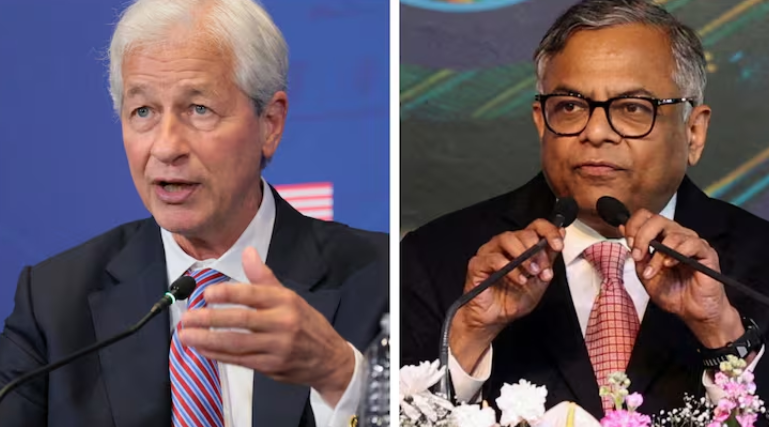
22 September 2026 (Navroze Bureau) : JPMorgan Chase CEO Jamie Dimon has voiced support for Tata Sons chairman N Chandrasekaran, while warning that the ongoing governance dispute between Tata Sons and Tata Trusts could affect foreign investor confidence and investment decisions.
Dimon said he had a high regard for Chandrasekaran and described him as an exceptional leader. He also said transparency, consistency in governance and clear rules were important for attracting global capital.
Dimon Raises Foreign Investment Concerns
Speaking to The Economic Times, Dimon said the conflict within one of India’s largest business groups could concern policymakers because prolonged governance uncertainty may deter foreign investment.
He stressed that investors generally look for consistency, transparency, regulations and sound board-level governance when making long-term investment decisions. Dimon also acknowledged that the Tata dispute is complex and said he did not know all the details.
Tata Sons Board and Tata Trusts at Odds
The comments come after the Tata Sons board reappointed Chandrasekaran for another five-year term and decided to move towards compliance with regulations requiring consideration of a public listing.
Tata Trusts, which owns about 66% of Tata Sons, opposed both decisions, according to Reuters. Trusts chairman Noel Tata objected to Chandrasekaran’s reappointment and the proposed listing, while Tata Sons has maintained that it will seek guidance from relevant stakeholders on the listing process.
The disagreement has brought the governance structure of the 158-year-old conglomerate into sharper focus.
Listing Debate Adds to the Dispute
One of the central disagreements concerns whether Tata Sons should pursue a public listing.
The Reserve Bank of India classified Tata Sons as an upper-layer non-banking financial company in 2022, bringing enhanced regulatory requirements, including a listing requirement. Reuters reported that the RBI recently rejected Tata Sons’ request to surrender its registration as a Core Investment Company.
The board subsequently decided to initiate steps towards compliance and seek guidance on the applicable requirements.
Tata Faces Major Investment Commitments
The governance dispute comes while the Tata Group is pursuing several large investment projects in areas including semiconductors, batteries, aviation, digital businesses and AI infrastructure.
A Moneycontrol analysis estimated that around ₹2.6 lakh crore has been committed or absorbed across major new ventures and turnaround businesses. The publication cautioned that the figure is an analytical estimate and does not represent Tata Sons’ direct funding requirement.
Major commitments cited in the analysis include investments in the Dholera semiconductor facility, the Jagiroad semiconductor assembly and testing plant, Agratas battery projects and AI data-centre infrastructure.
TCS Remains a Major Cash Source
Tata Sons also relies heavily on its stake in Tata Consultancy Services (TCS).
According to the Moneycontrol analysis, Tata Sons received ₹28,291 crore in dividends from TCS in FY26. However, TCS is itself navigating the rapid transformation of the IT-services industry caused by artificial intelligence.
This makes the performance and cash-generation capacity of the group’s technology business an important factor in Tata Sons’ broader capital allocation.
Air India Adds to Capital Requirements
The Tata Group is also investing heavily in Air India following its acquisition and subsequent merger with Vistara.
Air India’s turnaround requires substantial investment in fleet, operations and infrastructure. Singapore Airlines holds 25.1% of the enlarged airline, with the Tata Group holding the remaining 74.9%.
The airline therefore represents another major area where future capital allocation decisions may be significant.
Outside Investors Also Require Exit Options
Several Tata businesses have brought in outside investors to reduce the group’s immediate funding burden.
For example, TPG Rise Climate and Abu Dhabi’s ADQ invested ₹7,500 crore in Tata Passenger Electric Mobility in 2021. The investment structure included provisions for a potential investor exit in a later period, creating future decisions around valuation, ownership and liquidity.
No Sign Major Projects Have Been Halted
Despite concerns about the governance dispute, there is currently no indication that major Tata investment projects already underway have been stopped or delayed because of the conflict.
Tata companies have their own boards and management teams, while listed companies remain accountable to their shareholders. The concern is more about how future large capital-allocation and strategic decisions could be affected if the disagreement continues.
Dimon’s Support for Chandrasekaran
Dimon’s comments add an international investor perspective to the dispute.
He said he would not want to see Chandrasekaran leave Tata and argued that public transparency can be beneficial. At the same time, he emphasised that governance disagreements need to be resolved in a way that maintains investor confidence.
Governance Dispute Under Watch
The Tata Sons-Tata Trusts disagreement remains centred on leadership, governance and the future structure of the holding company.
For investors, the key issue is whether the dispute remains confined to Tata Sons’ boardroom or begins to influence capital allocation, strategic decisions and funding across the wider group