

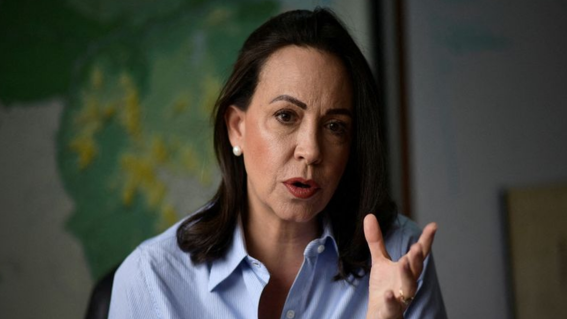
26 October 2026 (Navroze Bureau) Venezuelan opposition leader and Nobel Peace Prize laureate María Corina Machado has returned to her home country after nearly a year in exile, declaring “I am here. With you” as supporters welcomed her arrival. Her return comes at a crucial moment for Venezuela, as US-backed reconciliation talks continue amid uncertainty over the country’s political future and the timing of its next presidential election.
Machado announced her return on social media platform X on Sunday, October 25, 2026. She was greeted by supporters as she travelled towards Caracas, with crowds gathering along the route to welcome the prominent opposition figure and call for greater political freedom.
The 59-year-old leader had spent months outside Venezuela after leaving the country in December 2025 to receive the Nobel Peace Prize in Norway. Before her departure, she had spent an extended period in hiding amid a crackdown on opposition figures following Venezuela’s disputed 2024 presidential election.
Her return is significant because Machado has been largely excluded from the negotiations between Venezuela’s interim government and a section of the opposition. Her political movement has continued to demand free and fair elections and the restoration of democratic institutions.
US Secretary of State Welcomes Reconciliation Efforts
US Secretary of State Marco Rubio said the conditions that enabled Machado’s safe return were a direct result of Washington-supported reconciliation talks. He noted that the negotiations had already contributed to the release of political prisoners and the return of opposition figures from exile.
Rubio urged political groups across Venezuela to support the ongoing discussions, describing them as an important opportunity to achieve free and fair elections and establish a lasting democratic system.
The talks have focused on addressing political divisions and reforming key institutions, including the judiciary and electoral authorities. However, Machado’s political movement has not been included in the negotiations so far, raising questions about how broadly representative the process will be.
The US administration has prioritised political stability and economic recovery while seeking a path towards elections. Machado and her allies, meanwhile, have pressed for a clear election timetable and guarantees that the next vote will be conducted fairly.
Trump Says He Hopes Machado Is Safe
US President Donald Trump responded to questions about Machado’s return by saying he was unaware of the details but described her favourably and expressed hope for her safety.
Trump also reiterated that the United States was doing well in Venezuela. His administration has maintained relations with interim President Delcy Rodríguez, a former ally of ousted president Nicolás Maduro, whose government has cooperated with Washington on economic and energy-related matters.
The US position has drawn attention because Machado has long been a leading figure in the opposition movement and has advocated a democratic transition. Washington’s engagement with Rodríguez has therefore become a central issue in discussions about Venezuela’s future leadership.
Although Rubio publicly credited the reconciliation talks with creating conditions for Machado’s return, Trump’s remarks indicated that he did not claim direct knowledge of the details surrounding her arrival.
Venezuela’s Political Crisis Continues
Venezuela has faced years of political instability, economic hardship and disputes over the legitimacy of its leadership. The 2024 presidential election was particularly contentious: authorities declared Maduro the winner, while the opposition presented vote tallies that it said showed its candidate, Edmundo González Urrutia, had won.
Machado had been barred from contesting that election, prompting González to stand in her place. The aftermath of the vote was marked by arrests and a crackdown on opposition supporters.
The political situation changed dramatically in January 2026, when US forces captured Maduro. Rodríguez subsequently assumed the interim presidency with Washington’s support. However, a new presidential election has yet to be scheduled, and disagreements over the country’s political transition remain unresolved.
Machado’s return could strengthen the opposition’s public mobilisation, particularly as supporters continue to demand a clear path towards elections. Her allies have said she intends to meet families of political prisoners, representatives of the international community and other figures involved in the democratic movement.
Supporters Welcome Machado’s Return
Crowds gathered along Machado’s route towards Caracas, chanting for freedom and expressing support for her political campaign. Her arrival has renewed hopes among opposition supporters who see her return as an opportunity to intensify demands for democratic change.
Her political movement has called for elections in 2027 and wants Machado to be allowed to contest them. Whether she will be permitted to run and whether the authorities will agree to a firm electoral timetable remain unresolved questions.
The return also presents a challenge for the reconciliation process. While Washington has welcomed negotiations as a means of securing a peaceful political transition, the exclusion of Machado’s movement has raised concerns about whether the discussions can achieve broad opposition participation.
For now, the focus remains on whether political negotiations can lead to credible electoral guarantees, stronger democratic institutions and the protection of political freedoms.
Machado’s return marks a major development in Venezuela’s continuing political crisis. Her message, “I am here. With you,” has resonated with supporters, but the broader outcome will depend on whether the country’s political actors can agree on a peaceful and inclusive route towards free and fair elections.