

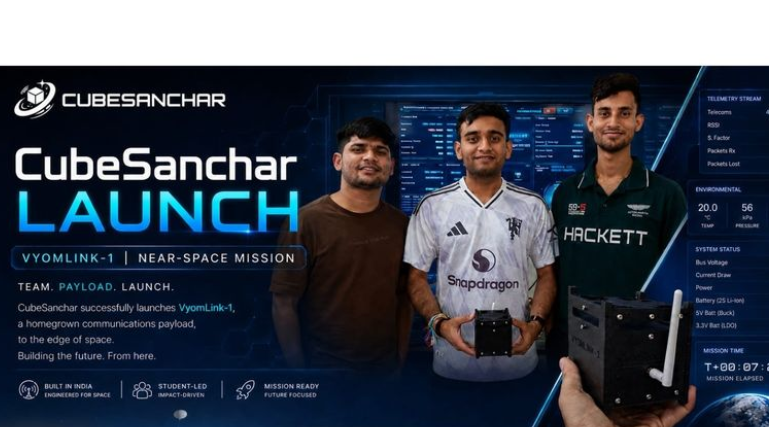
2 September 2026 (Navroze Bureau) Indian space-tech startup CubeSanchar has successfully completed the flight phase of VyomLink-1, a high-altitude balloon technology demonstration mission designed to test affordable data-relay communication systems for aerospace and remote-connectivity applications.
The mission demonstrated store-and-forward data relay up to approximately 10 km altitude, achieving 100% packet reception during the successful relay phase. The payload also continued transmitting health data from much higher altitudes, providing valuable information for the development of future communication systems.
100% Packet Reception During Relay Test
VyomLink-1 was designed as a compact near-space communication payload.
During the primary relay experiment, the system successfully received 20 out of 20 expected relay packets, resulting in a 100% packet reception rate with zero recorded packet loss.
The successful demonstration extended to an altitude of approximately 10 km and a slant range of around 16 km, validating the core store-and-forward capability under flight conditions.
Communication Continued Beyond 32.8 km
Although acknowledgements for newly transmitted store commands were no longer received beyond around 10 km, the payload itself continued functioning.
VyomLink-1 maintained communication while ascending beyond 32.8 km, with signals reportedly received over a slant range of approximately 68 km.
This suggests that the underlying communication architecture remained operational even after the primary store-and-forward experiment encountered an anomaly.
Post-10-km Anomaly Under Investigation
CubeSanchar said the cause of the interruption to the store-and-forward function beyond 10 km remains under investigation.
The company plans to examine the recovered hardware and onboard data to determine whether the issue was related to the receiving link, payload electronics, software, onboard storage or another flight-related factor.
The anomaly therefore does not erase the successful results achieved during the qualified relay phase, but it provides an important engineering challenge for the next iteration of the system.
Payload Survived Harsher Conditions Than Expected
The flight also served as an environmental test for the communication payload.
Before launch, VyomLink-1 had been qualified for temperatures of approximately -15°C to -24°C. During the actual flight, the payload continued operating in estimated temperatures of around -60°C to -80°C.
The performance provided real-world evidence that the system could function in substantially harsher conditions than those reproduced during its ground qualification tests.
From Laboratory Testing to Near-Space Validation
VyomLink-1 represents a step from laboratory and ground-based testing toward actual flight validation.
High-altitude balloons provide a useful platform for testing communication technologies because payloads can be taken into near-space environments without the cost and complexity of an orbital mission. Such platforms are also used globally for scientific and technology demonstrations.
Potential Applications
CubeSanchar is developing compact communication systems aimed at applications involving airborne platforms, drones, remote systems and aerospace networks.
Affordable data-relay technology could prove useful in locations where conventional connectivity is limited, particularly for remote operations and specialised aerospace missions.
The company says its broader objective is to make advanced data-relay capabilities more accessible through compact payloads, ground infrastructure and software-driven mission systems.
Mission Team and Development Support
The VyomLink-1 mission was executed by a CubeSanchar team comprising Mahir Chahwala, Krishnendra Singh, Pawan Kumar and Sai Prasad Dhodhi.
The team worked across payload development, electronics, software, testing, integration, communication systems and mission operations.
CubeSanchar also acknowledged support from STAR Labs Surat for payload development, testing facilities and mission preparation.
What Comes Next for VyomLink
The recovered payload and onboard records will be analysed in detail.
The findings from that analysis are expected to help determine the cause of the post-10-km store-and-forward anomaly and guide improvements to CubeSanchar’s next-generation communication architecture.
Despite the unresolved issue, the mission successfully demonstrated its primary relay capability and provided additional data on long-range communication and environmental performance.
A Step Towards Affordable Connectivity
VyomLink-1 highlights how high-altitude platforms can be used to bridge the gap between conventional ground-based communication systems and more expensive space-based infrastructure.
For CubeSanchar, the mission provides both a successful technology demonstration and a set of engineering lessons that could shape future near-space communication systems.