

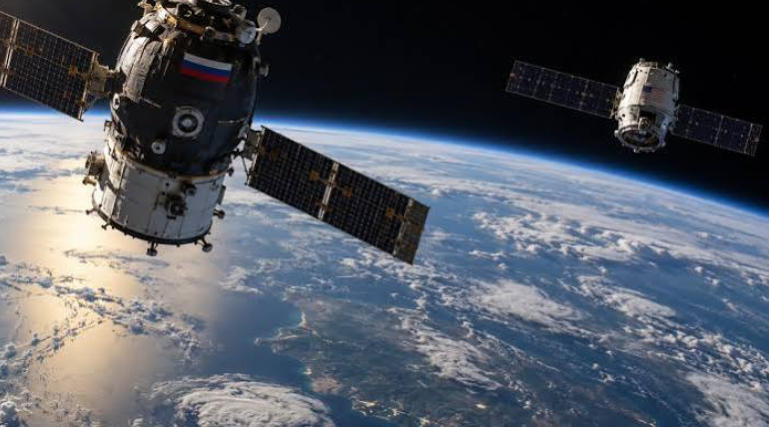
22 October 2026 (Navroze Bureau) The United States has accused Russia of engaging in potentially threatening activities in space after a Russian military satellite, Cosmos 2612, reportedly manoeuvred dangerously close to a commercial satellite. The incident has raised concerns about space security and the growing risks associated with military activities in Earth’s orbit.
Thomas G. DiNanno, the US Under Secretary of State for Arms Control and International Security, said Russia’s Cosmos 2612 had exhibited threatening behaviour by intentionally manoeuvring close to a commercial satellite. He described the activity as consistent with potential on-orbit weapons operations.
The statement was made during remarks associated with a United Nations First Committee meeting, where international security and arms-control issues are discussed.
Russian Satellite Reportedly Came Within 100 Feet
According to media reports, Cosmos 2612 came within approximately 100 feet of a commercial synthetic aperture radar satellite associated with US-Finnish company ICEYE. The satellite provides radar-imaging capabilities that have reportedly been used to support Ukraine.
Such a close approach has attracted attention because satellites operate at extremely high orbital speeds, and manoeuvring close to another spacecraft can raise concerns about collision risks, surveillance and possible interference.
US officials have argued that the reported manoeuvres crossed established safety expectations for activities in low Earth orbit. However, the precise purpose of the Russian satellite’s actions has not been independently established publicly.
Washington Warns About Space Security
The US government has emphasised that protecting its national security interests in space remains a priority. Washington is increasingly concerned about the potential use of satellites for military surveillance, intelligence gathering and operations designed to threaten or disable other spacecraft.
Commercial satellites have become particularly important in modern conflicts because they provide services such as radar imaging, communications and intelligence support. Their role has expanded significantly during the Russia-Ukraine war.
The reported incident has therefore renewed concerns about whether commercial spacecraft could become targets during geopolitical or military confrontations.
Why the Incident Matters for Ukraine
ICEYE is known for providing synthetic aperture radar (SAR) satellite imagery. Unlike conventional optical imaging satellites, SAR systems can capture useful images at night and through many cloud conditions.
These capabilities make radar imagery valuable for monitoring military movements, infrastructure and changing conditions on the ground.
Reports have linked the commercial satellite involved in the incident to intelligence support for Ukraine. If commercial spacecraft providing such services face increasing pressure or interference, the consequences could extend beyond the companies operating them to the governments and organisations relying on their data.
Nevertheless, the reported close approach does not by itself establish that Russia intended to attack or disable the satellite.
Growing Competition in Earth’s Orbit
The incident highlights a broader challenge facing the international community: the growing importance of space infrastructure to national security and the global economy.
Governments depend on satellites for communications, navigation, weather forecasting and intelligence. Commercial operators also provide services that support transport, agriculture, emergency response and defence.
As more countries develop sophisticated space capabilities, close-proximity manoeuvres between satellites have become an increasingly important security concern. Such activities can be difficult to interpret because the purpose of a spacecraft cannot always be determined from its movements alone.
Experts and officials have consequently called for greater transparency, improved space monitoring and clearer international standards governing responsible behaviour in orbit.
Diplomatic Tensions Remain in Focus
The latest US statement comes amid continuing diplomatic efforts concerning the war in Ukraine and wider relations between Washington and Moscow.
Concerns over military activities in space add another dimension to an already complex relationship. The incident may increase pressure for further discussions about space safety, military transparency and the protection of commercial infrastructure.
However, the available public information does not establish that an attack occurred or that the commercial satellite sustained damage.
What Happens Next?
The immediate focus will be on monitoring the satellites’ movements, assessing the nature of the close approach and determining whether further diplomatic or security measures are necessary.
The episode also underlines the need for countries to establish reliable communication channels and shared expectations for safe satellite operations.